

Personal Knowledge Ark for digital survival in a grid-down future, dark futurism style. Future of Humanity

The Offline Internet: How to Build a Personal “Knowledge Ark” for a Grid-Down Future

  • fevereiro 21, 2026

The collapse of global connectivity in 2026 is no longer a fringe conspiracy, but a systemic vulnerability documented by subsea cable failures and escalating cyber warfare. Building a personal “Knowledge Ark” involves decentralizing critical data onto resilient hardware — local servers and Mesh networks — ensuring access to survival manuals, maps, and financial records without […]

A hyper-realistic young woolly mammoth walking through the snowy Alaskan tundra, with a scientific research base and climate scientists in the background, representing de-extinction and climate change efforts. Tech Ethics

The Mammoth’s Burden: Can De-extinction and Climate Change Mitigation Coexist?

  • fevereiro 18, 2026

Deep within the Alaskan permafrost lies a geochemical “methane bomb” accumulated over ten millennia. If this layer thaws, it threatens to release a volume of greenhouse gases exceeding the total cumulative emissions of the Industrial Age. Curiously, the most sophisticated climate engineering solution proposed today is not a new carbon-capture turbine, but a six-ton biological […]

A holographic neon blue sign reading "SeeDance 2.0" shines atop the Hollywood Hills, positioned above the original Hollywood sign which appears broken, old, and in ruins. News

Why SeeDance 2.0 is the End of the Hollywood Monopoly

  • fevereiro 15, 2026

The Great Illusion of “Artistic Death” For the past two years, the headlines have been a chorus of doom: “AI is killing the artist,” “The end of human creativity,” “The death of cinema.” They are wrong. AI isn’t killing art; it’s killing gatekeepers. What we are witnessing with the launch of SeeDance 2.0 is the […]

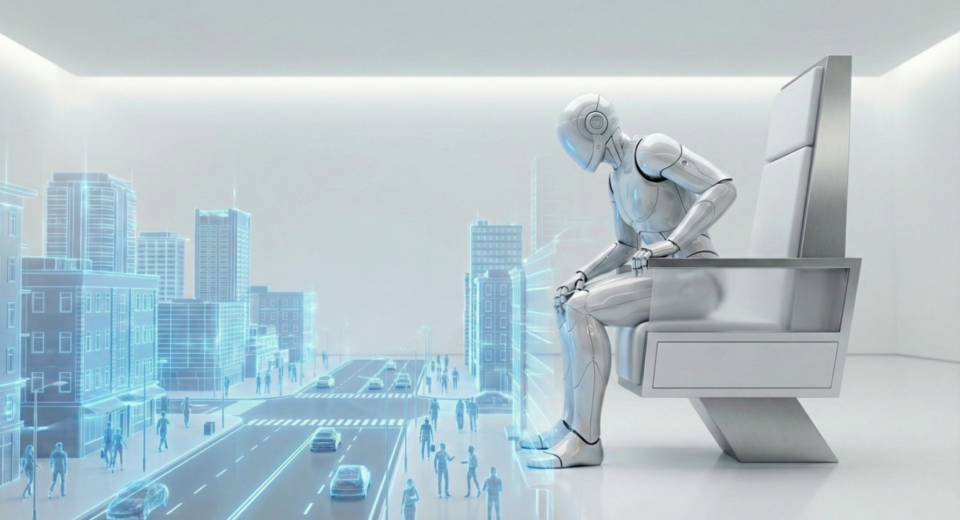
A sleek white humanoid robot sitting in a high-tech judicial chair, looking down at a holographic blueprint of a digital smart city with blue data streams. Tech Ethics

How Predictive Policing Algorithms are Rewiring the Smart City

  • fevereiro 10, 2026

The knock at the door arrives not as a result of a witnessed transgression, but as the output of a statistical probability. You haven’t been reported; your record remains pristine. Yet, somewhere in a climate-controlled data center, an artificial intelligence has assigned an 87% probability to the likelihood of you committing a crime within the […]

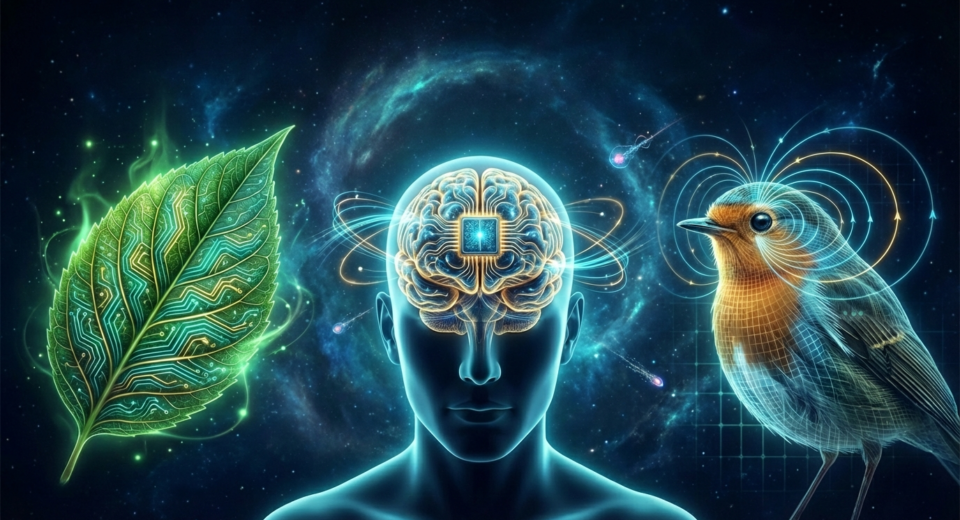
An artistic composition of a quantum human brain, a leaf with biological circuits, and a bird navigating magnetic fields, representing the union between biology and quantum technology. Future of Humanity

How Quantum Biology is Architecting the Future of Technology

  • fevereiro 9, 2026

The Schrödinger Legacy In 1944, the physicist Erwin Schrödinger published What is Life?, a seminal work that posited a daring hypothesis: biological organisms are not merely governed by the classical laws of thermodynamics, but by the “order-from-order” principles of subatomic physics. For decades, the scientific community relegated this to the realm of theoretical curiosity, assuming […]

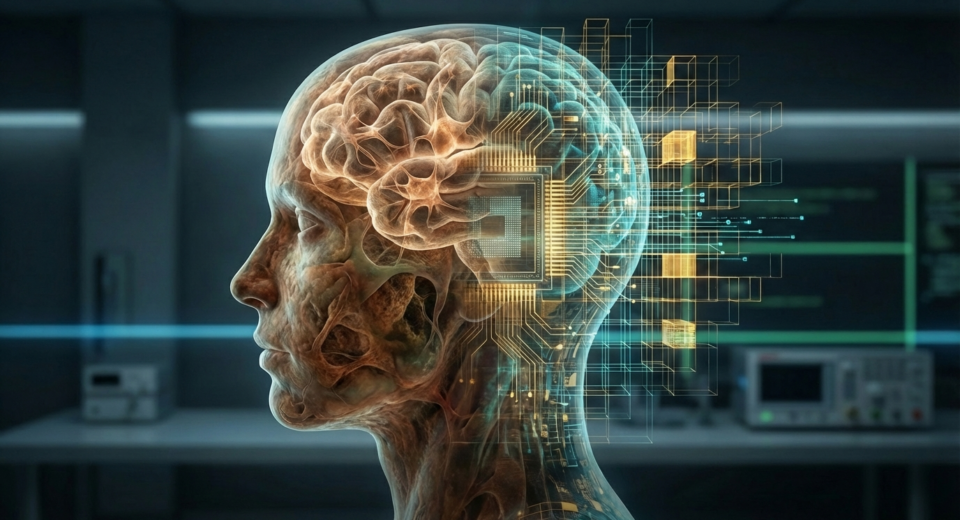
Conceptual visualization of digital consciousness and matrix reality: the fusion of biological neural networks with quantum computing architecture and data flows. Future of Humanity

Digital Consciousness: The Convergence of Neuro-Engineering and Quantum Computing

  • fevereiro 7, 2026

The boundary between biological intelligence and synthetic substrate is no longer a matter of science fiction, but a timeline of engineering milestones. As we move toward the mid-21st century, the concept of Digital Consciousness and the Matrix Reality has transitioned from philosophical thought experiments — like Hilary Putnam’s “Brain in a Vat” — to a […]

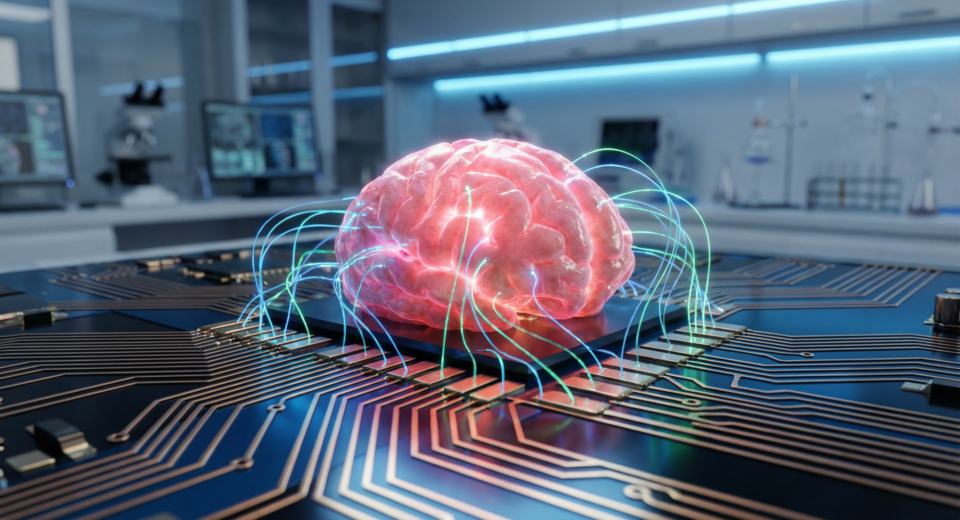
Representation of human biocomputing with a brain organoid connected to electronic circuits. News

Human Biocomputing: The Day Silicon Bowed to the Living Neuron

  • fevereiro 5, 2026

In the last 24 hours, the emerging technology landscape was confronted with a breakthrough that challenges the boundaries of bioethics: the maturation of human biocomputing. Recent reports from Nature and MIT Technology Review detail how brain organoids — tissues grown from human stem cells — are being integrated into electronic circuits to perform data processing […]

  • 1
  • 2

Damos valor à sua privacidade

Nós e os nossos parceiros armazenamos ou acedemos a informações dos dispositivos, tais como cookies, e processamos dados pessoais, tais como identificadores exclusivos e informações padrão enviadas pelos dispositivos, para as finalidades descritas abaixo. Poderá clicar para consentir o processamento por nossa parte e pela parte dos nossos parceiros para tais finalidades. Em alternativa, poderá clicar para recusar o consentimento, ou aceder a informações mais pormenorizadas e alterar as suas preferências antes de dar consentimento. As suas preferências serão aplicadas apenas a este website.

Cookies estritamente necessários

Estes cookies são necessários para que o website funcione e não podem ser desligados nos nossos sistemas. Normalmente, eles só são configurados em resposta a ações levadas a cabo por si e que correspondem a uma solicitação de serviços, tais como definir as suas preferências de privacidade, iniciar sessão ou preencher formulários. Pode configurar o seu navegador para bloquear ou alertá-lo(a) sobre esses cookies, mas algumas partes do website não funcionarão. Estes cookies não armazenam qualquer informação pessoal identificável.

Cookies de desempenho

Estes cookies permitem-nos contar visitas e fontes de tráfego, para que possamos medir e melhorar o desempenho do nosso website. Eles ajudam-nos a saber quais são as páginas mais e menos populares e a ver como os visitantes se movimentam pelo website. Todas as informações recolhidas por estes cookies são agregadas e, por conseguinte, anónimas. Se não permitir estes cookies, não saberemos quando visitou o nosso site.

Cookies de funcionalidade

Estes cookies permitem que o site forneça uma funcionalidade e personalização melhoradas. Podem ser estabelecidos por nós ou por fornecedores externos cujos serviços adicionámos às nossas páginas. Se não permitir estes cookies algumas destas funcionalidades, ou mesmo todas, podem não atuar corretamente.

Cookies de publicidade

Estes cookies podem ser estabelecidos através do nosso site pelos nossos parceiros de publicidade. Podem ser usados por essas empresas para construir um perfil sobre os seus interesses e mostrar-lhe anúncios relevantes em outros websites. Eles não armazenam diretamente informações pessoais, mas são baseados na identificação exclusiva do seu navegador e dispositivo de internet. Se não permitir estes cookies, terá menos publicidade direcionada.

In order for Future Society Journal to function properly and provide a personalized experience, we use cookies in accordance with our [Privacy Policy].