


For decades, our collective gaze has been fixed on the wrong horizon. We have been conditioned to look toward the red. Mars dominated our imagination, promising a second home — a broken Earth we could theoretically fix. But let’s be honest: a silent fatigue is setting in. Red dust has become routine.
While we dream of terrariums and gardens under Martian domes, we are ignoring something far more visceral. We ignore the world that doesn’t ask to be fixed, but demands to be feared. We have forgotten the little brother, the first in line.
For a long time, history books described it as a dead rock baking in oblivion. We were wrong. This is Planet Mercury. And it is not a dead world; it is the Engine of the Solar System
The Phenomenology of Hell
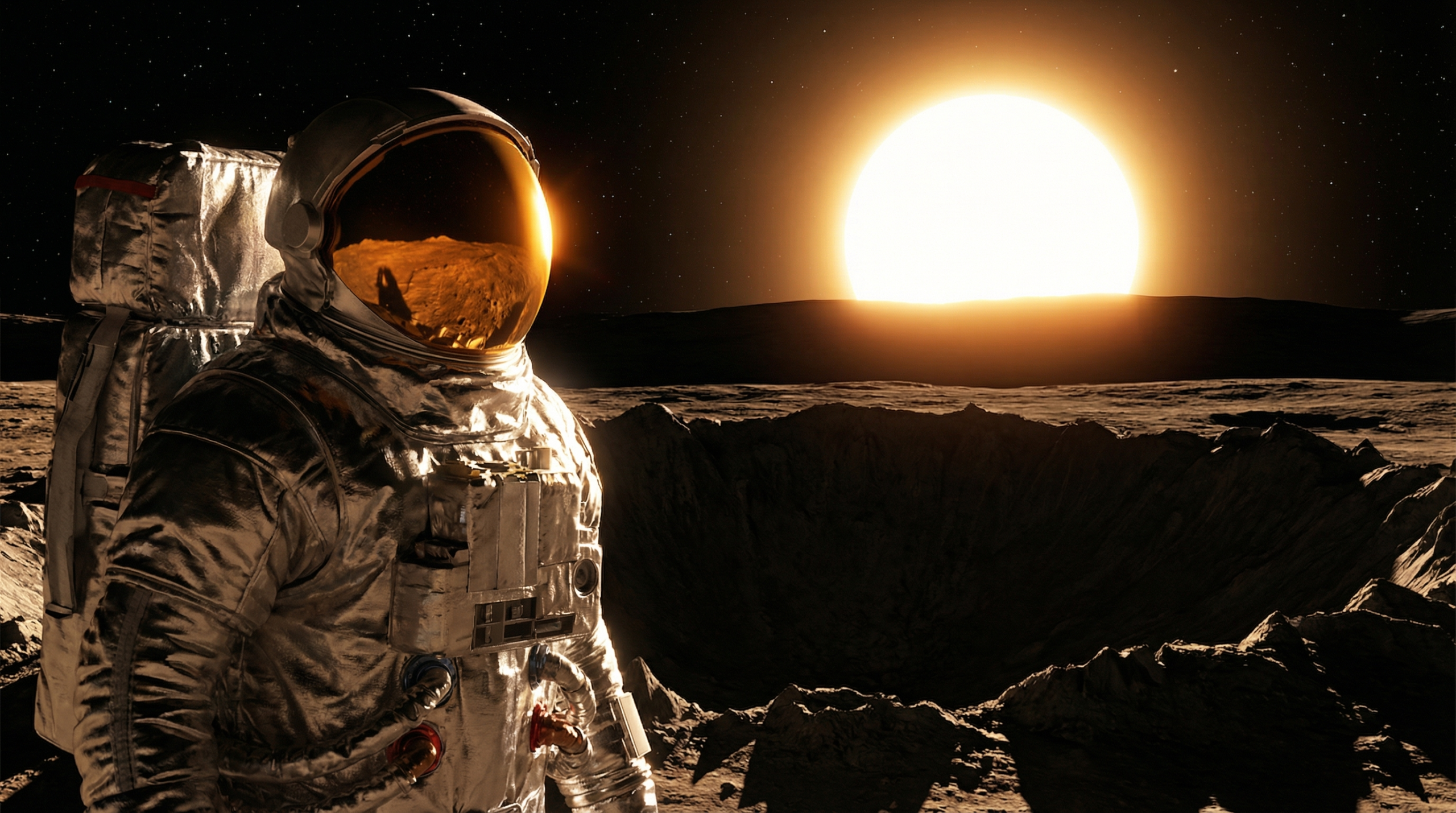
To understand why Mercury is the ultimate frontier, you must first unlearn everything you know about light. On Earth, light is gentle; it scatters and paints the sky blue. On Mercury, light is a tyranny.
Imagine standing on the surface. The Sun isn’t a distant disk; it is a colossal presence, looming three times larger than anything seen from Earth. The radiation strikes with a violence of ten thousand watts per square meter — it isn’t just glare; it is physical pressure.
Yet, the sky is wrong. At noon, with the Sun blazing, the sky remains pitch black. Without a thick atmosphere to scatter light, there is no blue day — only a brutal contrast between blinding white ground and an infinite abyss.
It is a world of absolutes. One step into the light is incineration; one step into a rock’s shadow is instant freezing.
Note: The silence of Mercury is absolute. Rocks crack and explode under the heat, but hell is mute. The only sound is your own breathing and the metallic creaking of your suit fighting the thermal expansion.
The Temporal Prison: When Time Drags
On Earth, time flows. On Mercury, it drags. The planet is locked in a hypnotic gravitational waltz with the Sun — a 3:2 resonance where it spins only three times on its axis for every two laps around the star.
This creates a reality that defies human biology: a single day lasts longer than a year. Specifically, 176 Earth days pass from sunrise to sunrise. The Sun hangs in the sky like an unblinking eye for three uninterrupted months, cooking the ground.
And when dusk finally arrives, it isn’t a romantic sunset — it’s an evacuation warning. The night creates a deep, instant winter where temperatures plummet to -180 degrees.
The Architecture of Survival
So, how do we live in hell? Forget the fragile glass domes of sci-fi. On Mercury, glass melts. We need brutalist engineering. We have three paths to cheat death:
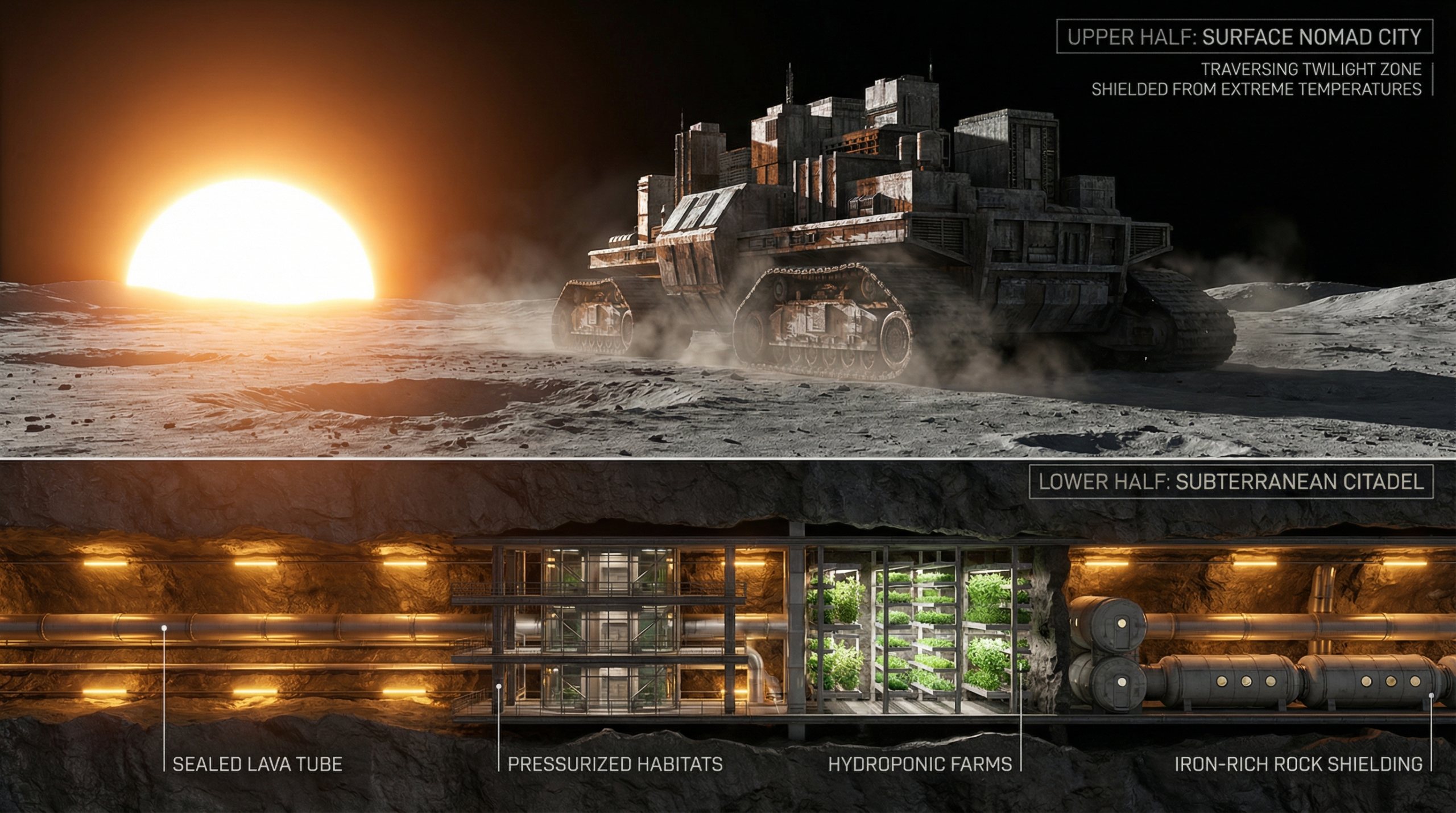
1. The Nomad City (Running from the Sun)
Mercury’s slow rotation offers a loophole. At the equator, the terminator line (the division between day and night) moves at just 3.6 km/h. A human can literally walk faster than the sunrise.
The Concept: Entire metropolises mounted on gigantic caterpillar tracks, moving perpetually west.
The Goal: To stay in the “twilight zone” — the safe edge between roasting heat and freezing cold.
2. Polar Citadels (Hiding in the Dark)
At the poles, deep craters exist where sunlight hasn’t entered for billions of years. In these shadows, the Messenger probe found the unthinkable: ice.
The Concept: Cities hidden in eternal darkness, powered by “Peaks of Eternal Light” — giant mirrors on crater rims that reflect solar energy down to the base.
3. Technological Troglodytes (Buried in Iron)
The safest protection is the planet’s own crust. Mercury is rich in silicates and ancient lava tubes.
The Concept: Pressurized underground cities protected by kilometers of rock, safe within the planet’s iron belly.
Why Bother? The Energy Future
Why go to a place that shakes, burns, and evaporates? Why not stay with the safety of Mars?
The answer is simple: Power.
Mars is a place where we can live. Planet Mercury is the place that will allow us to evolve. Solar energy here is ten times more potent than on Earth. We wouldn’t go there to farm; we would go to build the greatest structure in human history: a Dyson Swarm.
We would use Mercury’s abundant iron to manufacture trillions of autonomous mirrors. These wouldn’t block the sun, but envelop it like a living cloud of gold and silicon.
Final Verdict
Mercury is hot, dangerous, and unforgiving. It tests us in ways Mars never could. But in the Sun’s forge, humanity’s future won’t just be planted like a garden — it will be built in iron and light.
The question isn’t whether we can survive Mercury. It’s whether we are brave enough to abandon the comfort of the Red Planet for the power of the Forge.
Selected Bibliography & Further Reading
On Mercury’s Geology & The “Hollows” Mystery
Blewett, D. T., et al. (2011). “Hollows on Mercury: MESSENGER Evidence for Geologically Recent Volatile-Related Activity.” Science, 333(6051), 1856-1859.
Context: Supports the section on the “Hollows” and the planet “evaporating”.
Watters, T. R., et al. (2016). “Recent Tectonic Activity on Mercury Revealed by Small Thrust Fault Scarps.” Nature Geoscience, 9, 743–747.
Context: Supports the claim that Mercury is shrinking and tectonically active.
On The Polar Ice & Water
Lawrence, D. J., et al. (2013). “Evidence for Water Ice Near Mercury’s North Pole from MESSENGER Neutron Spectrometer Measurements.” Science, 339(6117), 292-296.
Context: The scientific proof for the “Polar Citadels” and ice in the craters.
On Orbital Mechanics & General Relativity
Park, R. S., et al. (2017). “Precession of Mercury’s Perihelion from Ranging to the MESSENGER Spacecraft.” The Astronomical Journal, 153(3).
Context: Modern verification of Einstein’s General Relativity using Mercury’s orbit.
Colombo, G. (1965). “Rotational Period of the Planet Mercury.” Nature, 208, 575.
Context: The original paper explaining the strange 3:2 spin-orbit resonance.
On Energy & The Dyson Swarm Concept
Dyson, F. J. (1960). “Search for Artificial Stellar Sources of Infrared Radiation.” Science, 131(3414), 1667–1668.
Context: The foundational text for the “Dyson Swarm” concept mentioned in the conclusion.
Armstrong, S., & Sandberg, A. (2013). “Eternity in Six Hours: Intergalactic Spreading of Intelligent Life and Reshaping the Universe.” Acta Astronautica, 89, 1-13.
Context: Explores the logistics of dismantling planets (like Mercury) for solar energy harvesting.
Speculative Engineering & Colonization
Robinson, K. S. (2012). 2312. Orbit Books.
Context: While fiction, this Nebula Award-winning novel is credited with popularizing the “Terminator City” (Nomad City) concept rolling around Mercury to stay in the twilight.
“Hollows” and the “Evaporating” Planet
Scientific Article: Blewett, D. T., et al. (2011). Craters on Mercury: Evidence from the MESSENGER Mission of Recent Activity Related to Volatile Substances. Science. Access Original Publication (Science Magazine)