


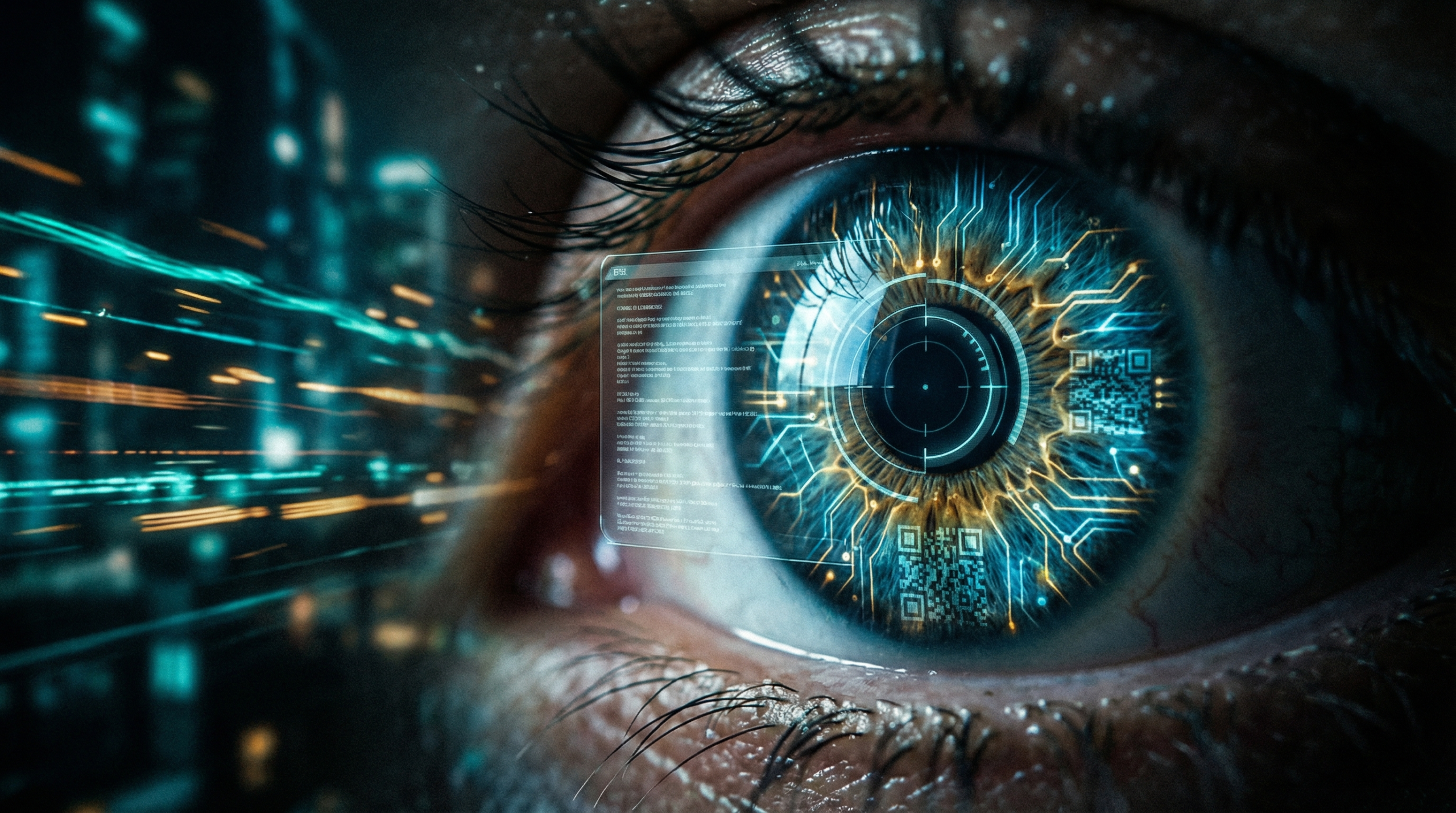
The race to distinguish humans from synthetic agents has reached a tipping point. With the surge in autonomous bot activity in 2026, institutions such as the World Economic Forum and Gartner are accelerating the adoption of Proof of Personhood protocols. What is being marketed as a solution against deepfakes is turning into a biopolitical surveillance infrastructure, where access to digital citizenship requires the surrender of irrevocable biological data.
The Future Society Perspective: The New Glass Contract
Historically, anonymity was the fertile ground for revolutions. If the 20th-century struggle was for the right to be “counted” by the State, in 2026, the struggle has flipped: we are forced into radical biological transparency to avoid being silenced as “AI noise.” This transition bears a dangerous resemblance to Jeremy Bentham’s Panopticon — an architecture where everyone is observed, but no one knows when. The difference is that the modern Panopticon is built with retina scans and rhythmic typing patterns.
The Political Economy of Identity
We are not just talking about security, but about a new commodification of being. By turning biometrics into a universal access key, we create a market where human identity is the ultimate asset. Companies that hold validation protocols become the new “feudal lords” of digital access. Those who control the gatekeeping of humanity control, by extension, who can consume, transact, and exist in the Web3 economy.
Global Inequality and Concrete Exclusion
The cost of “certified humanity” is not distributed equally. While citizens in the Global North access high-precision scanning devices, populations in regions with precarious infrastructure face concrete exclusion. If you lack access to validation hardware or if your biometrics do not fit algorithmic standards (which are often biased), you are technically “dehumanized” by the system. We are thus creating a global underclass of “digital ghosts” — real humans who are invisible to credit, healthcare, and communication protocols.
The Inevitability Trap
We must reject the narrative that this surveillance is an inevitable byproduct of progress. “Inevitability” is a rhetorical tool used to stifle ethical debate before it even begins. Proof of Personhood is a political choice, not a law of physics. Alternative paths exist, such as trust systems based on social graphs and reputation networks, which do not require the expropriation of biological data.
The Psychological Impact: Algorithmic Self-Styling
Living under the constant need to “prove oneself human” generates deep existential stress. The long-term psychological impact is the erosion of spontaneity. When we know that every behavioral pattern is monitored to validate our identity, we begin to behave mechanically, shaping our “humanity” so that it is legible to the code. It is the ultimate paradox: to be accepted as human by the machine, we start acting like machines.
A Moral Mirror
The future scenarios of 2026 serve as a moral mirror for the present. If we accept that proof of life is the only toll for social participation, we are not saving online truth; we are building a high-fidelity prison where the right to error and anonymity has been extinguished.
If your identity becomes the property of third parties to ensure your safety, do you still own yourself, or are you just a tenant in your own digital body?
Selected Editorial References
World Economic Forum (WEF): How digital identity can improve lives in a digital economy – This report details the global elite’s vision for digital identity implementation and the risks of exclusion discussed here.
MIT Technology Review: The identity of the future will be biometric and decentralized – An in-depth technical analysis regarding the migration from facial recognition to blockchain protocols and the end of traditional passwords.
Electronic Frontier Foundation (EFF): Decentralized ID vs. Privacy – The foundation for our critique on how “secure” systems can be repurposed for government tracking.
Gartner Research: Predicts 2026: The Rise of Synthetic Entities – Projections on the collapse of online trust due to the advancement of generative AI.