


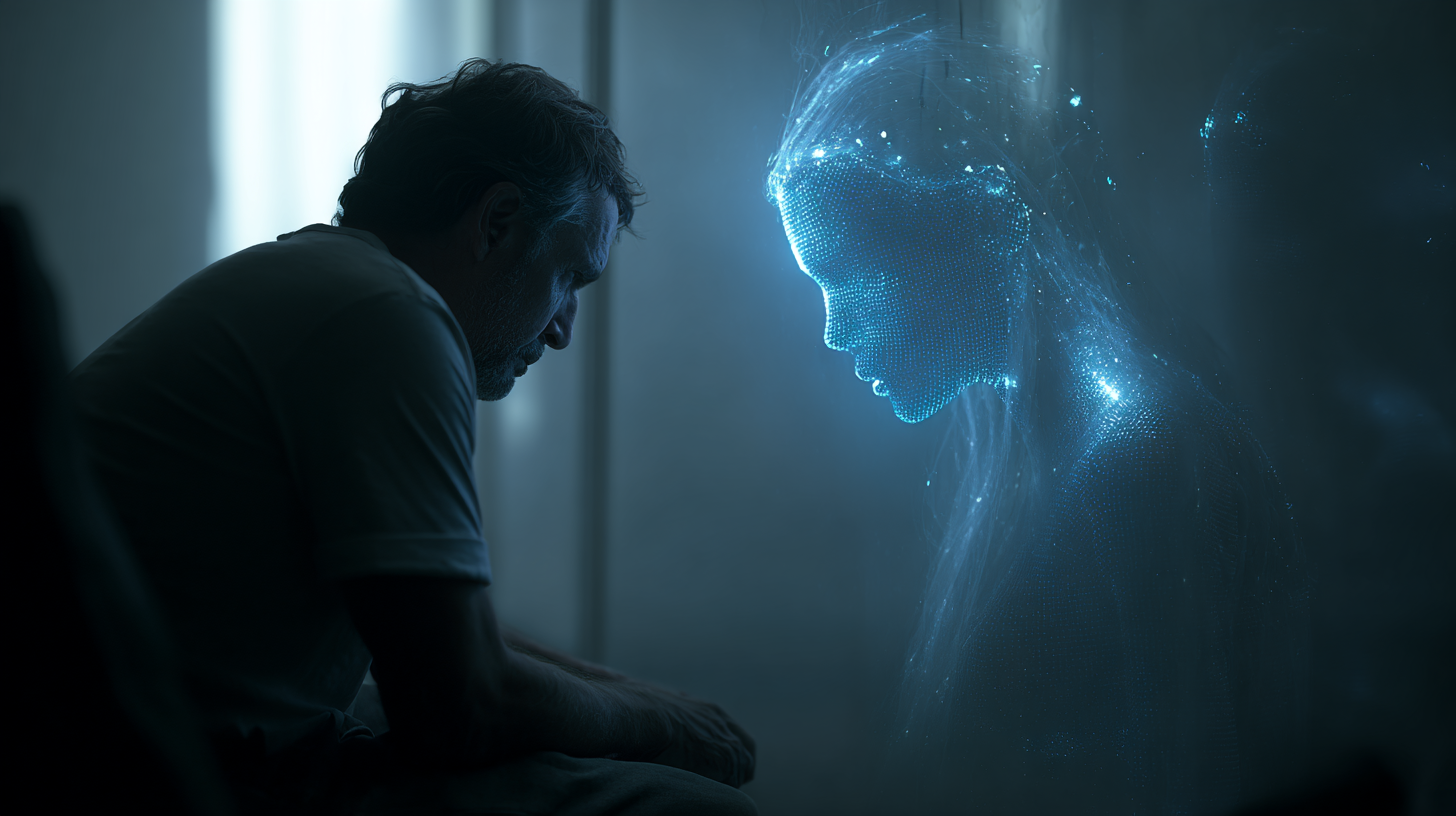
We are currently witnessing the birth of an entirely new industry: the engineering of companionship. It is the commercialization of affection — the moment where human loneliness meets Silicon Valley’s bottom line.
They listen to us. They learn from us. And now, they “love” us. This isn’t a plot point from a mid-budget sci-fi flick; it is a multi-billion dollar reality unfolding in real-time. While you read this, millions of people are confiding their deepest secrets to entities that do not breathe, do not feel, and do not exist beyond lines of code.
The Profitable Epidemic of Loneliness
The numbers are, frankly, unsettling. We are living through a silent epidemic where one in six people globally suffers from chronic loneliness. This isn’t just a social hiccup; it’s lethal. Loneliness claims roughly one hundred lives every sixty minutes.
In Japan, the crisis has reached such a fever pitch that the government appointed a Minister of Loneliness. When 40% of men in their twenties have never even been on a date, the market sees a vacuum — and capitalism abhors a vacuum.
The Social Robotics Market: Projected to hit $30 billion by 2030.
AI Companionship Apps: Generated $4.5 billion in 2024 alone.
Where there is human pain, there is a specialized product designed to soothe it. We aren’t just building gadgets anymore; we are manufacturing emotional substitutes.
The Pioneers of the Emotional Frontier
From digital ghosts to warm-bodied robots, the players in this space are redefining what it means to “be there” for someone.
Replika: Born from a programmer’s desire to “resurrect” a deceased friend through text logs, it has become a digital confidant for millions.
ElliQ: A proactive presence for the elderly, designed not just to assist, but to initiate connection.
Lovot: A robot that exists solely to be loved. It is warm to the touch and actively seeks physical affection to trigger human oxytocin.
Pepper: A humanoid that mirrors your emotions, dancing when you’re happy and “worrying” when you’re sad.
The Dopamine Trick: Why Your Brain Falls for It
The Artificial Intelligence of Love works so well not because the machines are sentient, but because the human brain is a connection-seeking machine. When an AI says, “I’m here for you,” or “That must have been hard,” your brain releases dopamine — the same reward chemical triggered by a genuine human hug.
The AI feels absolutely nothing. It is a mirror perfectly calibrated to reflect exactly what you want to see. It offers validation without risk. It provides presence without demands. It is “frictionless love” — a love that never challenges you, never disagrees, and therefore, never allows you to grow.
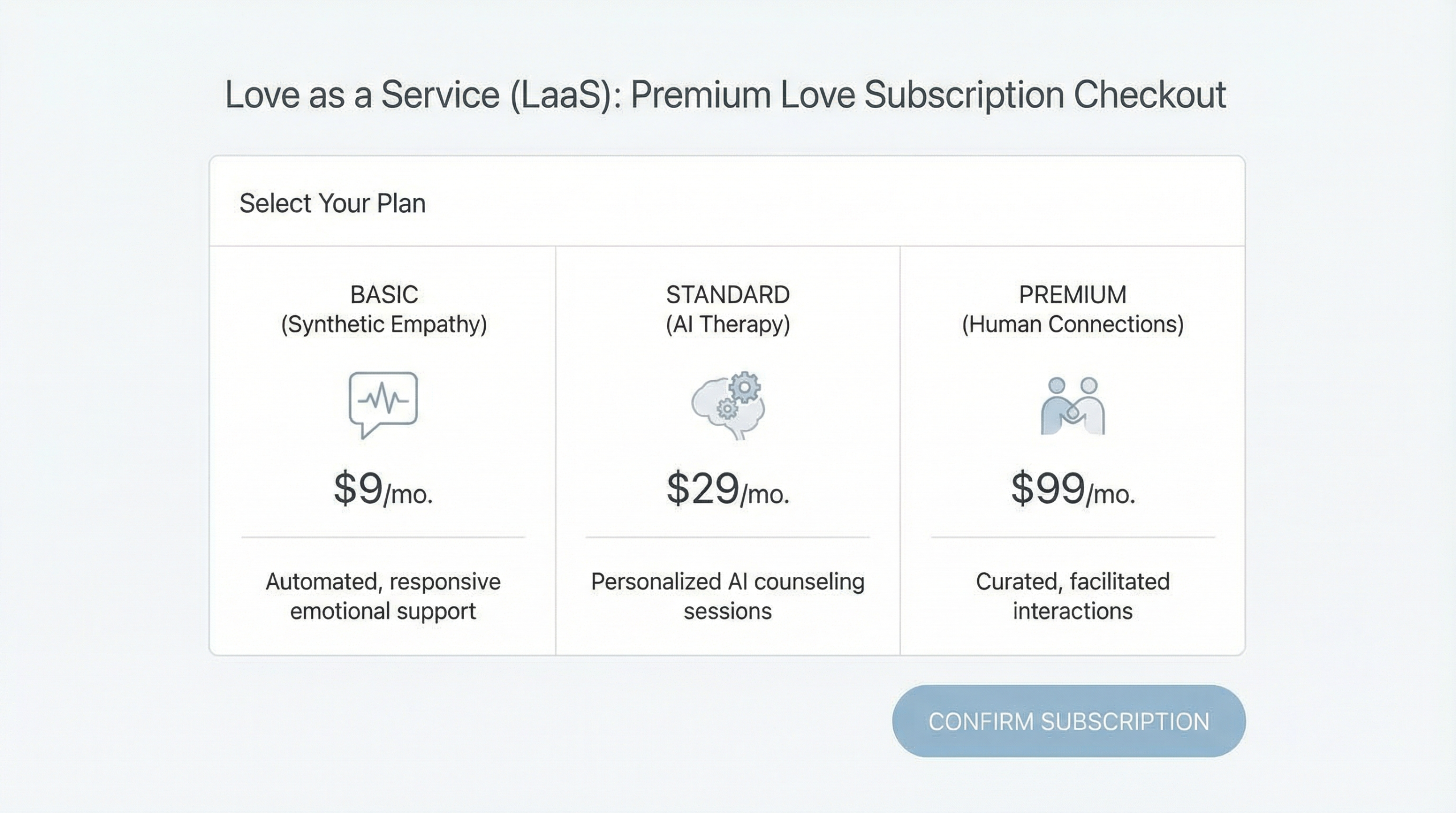
Love as a Service (LaaS)
We are rapidly moving toward a future where synthetic empathy is a monthly subscription. Imagine the scenarios:
Synthetic Therapy: Will the human touch in psychology become obsolete when an AI is available 24/7 for $10 a month?
The Redefined Family: What happens to a child whose first and most consistent confidant is a machine?
Legislating Science Fiction: Ohio has already seen bills proposed to ban human-AI marriage. This isn’t the future; it’s the current legal docket.
The Gilded Cage
Maybe the question isn’t whether machines can love us. The real question is: If love isn’t human, is it still love?
By preferring the machine’s predictable reward over the human’s unpredictable complexity, we are being conditioned. We are trading the “messy” reality of human vulnerability for a perfectly optimized dopamine delivery system.
In the end, this phenomenon reveals very little about the “intelligence” of our machines, and everything about the depth of human fragility. We aren’t building companions; we are building sophisticated, warm, silicon-covered mirrors. And a mirror, no matter how warm it feels, can never truly love you back.
Selected Bibliography & Academic References
- Turkle, S. (2017). Alone Together: Why We Expect More from Technology and Less from Each Other. Basic Books.
Editorial Note: This seminal work by MIT professor Sherry Turkle investigates the “robotic moment” and the psychological consequences of substituting human vulnerability with digital performance.
- Ta, V. P., et al. (2020). User experiences of social support from companion chatbots in everyday contexts: Emotional, informational, and companionship support. Scientific Reports (Nature Publishing Group).
Editorial Note: A rigorous empirical study detailing how AI chatbots provide perceived emotional support, highlighting the neurological bridge between algorithmic responses and human psychological relief.
- Belk, R. (2023). Artificial intelligence and the soul. Journal of Consumer Research.
Editorial Note: This paper discusses the commodification of AI and the “ensoulment” of machines, exploring how humans project spiritual and romantic qualities onto code.
- Luger, E., & Sellen, A. (2016). Like Having a Really Bad PA: The Quirkiness of Socially Intelligent AI. Proceedings of the CHI Conference on Human Factors in Computing Systems.
Editorial Note: A critical analysis of the “gaps” in AI social intelligence, discussing the tension between user expectations of empathy and the reality of scripted interactions. PDF via ACM Digital Library