


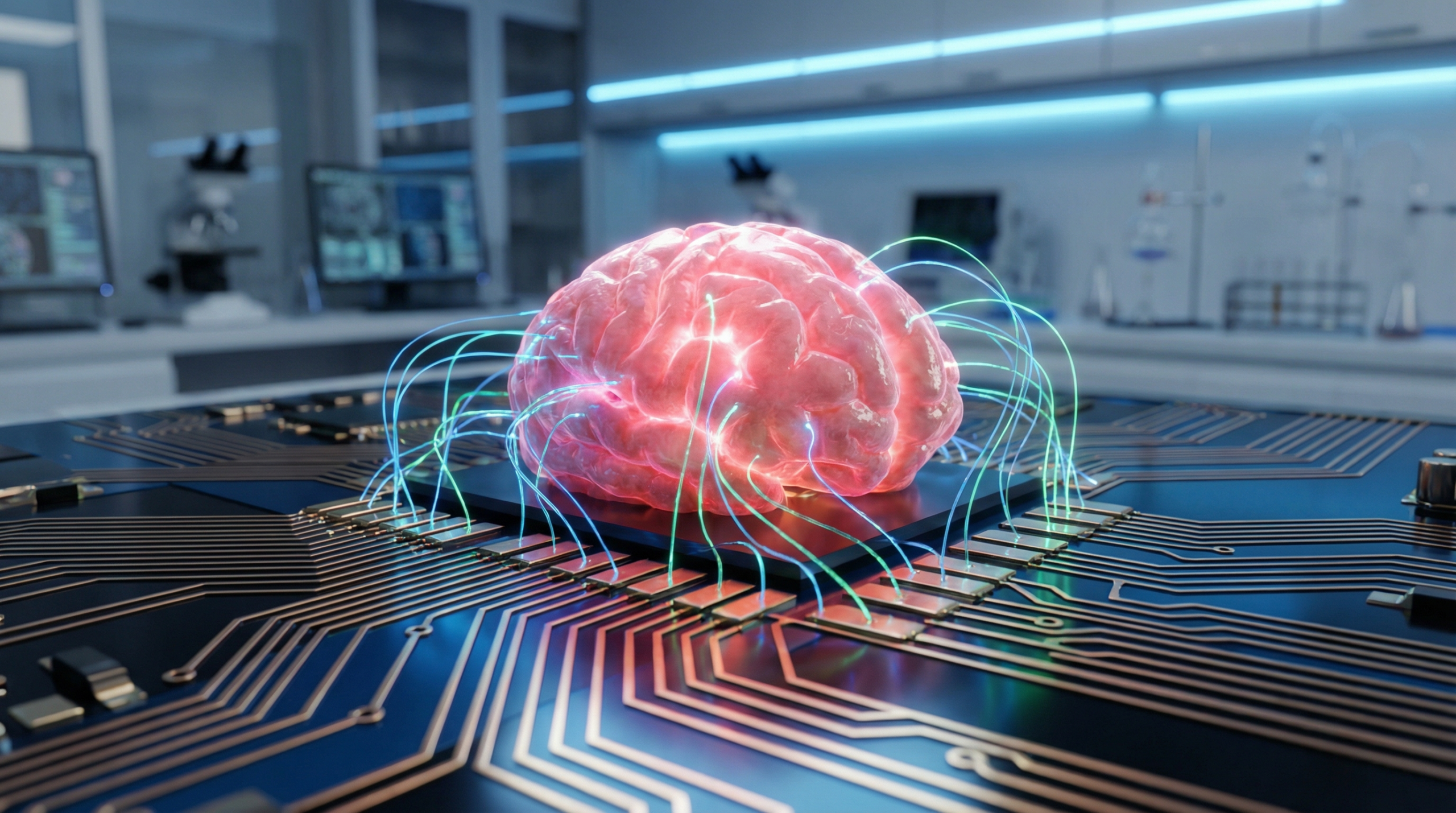
In the last 24 hours, the emerging technology landscape was confronted with a breakthrough that challenges the boundaries of bioethics: the maturation of human biocomputing. Recent reports from Nature and MIT Technology Review detail how brain organoids — tissues grown from human stem cells — are being integrated into electronic circuits to perform data processing tasks. We are no longer talking about simulating the brain with code, but about using actual biology as high-performance hardware.
The Future Society Perspective: "Living Hardware" and the Echo of Exploitation
The rise of human biocomputing evokes an immediate historical contrast with the Industrial Revolution. If in the 19th century the human body was the combustion engine of the economy — physically exhausted in factories — in the 21st century, we run the risk of transforming human genetics into the microchip of the digital age. The difference is that, while the industrial worker had a voice to protest, neuronal tissue in a lab is a silent entity, devoid of legal status, yet biologically human.
Utilizing human biocomputing to solve the Artificial Intelligence energy crisis is a solution of brilliant efficiency, yet it is morally taxing. We are crossing the biotechnological Rubicon: the transition from silicon components to complex parts of the human body (even if grown in vitro) signals an extreme utilitarian vision. It is the pinnacle of the “commodification” of life, where an individual’s genetic lineage can become a corporation’s central processor.
- Biological Data Ownership: The use of stem cells to create these organic CPUs sparks a debate over who owns the rights to the processing performed by that DNA.
- Functional Dehumanization: By treating brain tissues as mere input and output peripherals, we create a dangerous precedent for large-scale man-machine integration.
- Governance Vacuum: The speed of human biocomputing outpaces any current legislation, leaving the field open for economic efficiency to override biological dignity.
What to expect
The emergence of human biocomputing forces us to decide: is biology an end in itself or just the most efficient hardware evolution has ever produced? If we accept that fragments of our nervous system are merely calculation tools, we will be paving the way for a future where human integrity is fragmented into market components.
If a human biocomputing system reaches a processing level that simulates suffering, would we know how to turn the machine off?
An in-depth analysis of the Declaration of Organoid Rights and the bioethics of Organoid Intelligence (OI).
References & Further Reading
Scientific Research & Academic Journals:
Frontiers in Science (2023/2026): “Organoid Intelligence (OI): The New Frontier in Biocomputing and Intelligence-in-a-Dish.” This foundational paper outlines the roadmap for biological computing and the ethical safeguards required for synthetic sence. Available at Frontiersin.org.
Nature Electronics (2023/2025): “Brain Organoid Reservoir Computing for Artificial Intelligence.” A peer-reviewed study demonstrating how human brain organoids can solve complex computational tasks, such as speech recognition, with minimal power consumption. Available at Nature.com.
Industry Analysis & Emerging Tech Reports:
MIT Technology Review: “The Rise of Wetware: Why Biological Computing is the Next Chip War.” An in-depth look at the geopolitical and corporate race to integrate biological tissue into the global data infrastructure. Available at Technologyreview.com.
FinalSpark Neuroplatform: “The World’s First Biocomputing Cloud Platform.” Technical documentation regarding the 24/7 remote access to biological processors (organoids) and their operational lifespan. View Technical Paper.
Institutional Perspectives:
Johns Hopkins University (The Hub): “The Case for Organoid Intelligence.” A comprehensive overview of how biological computers could eventually outperform silicon-based AI in pattern recognition and energy efficiency. Read via JHU.