


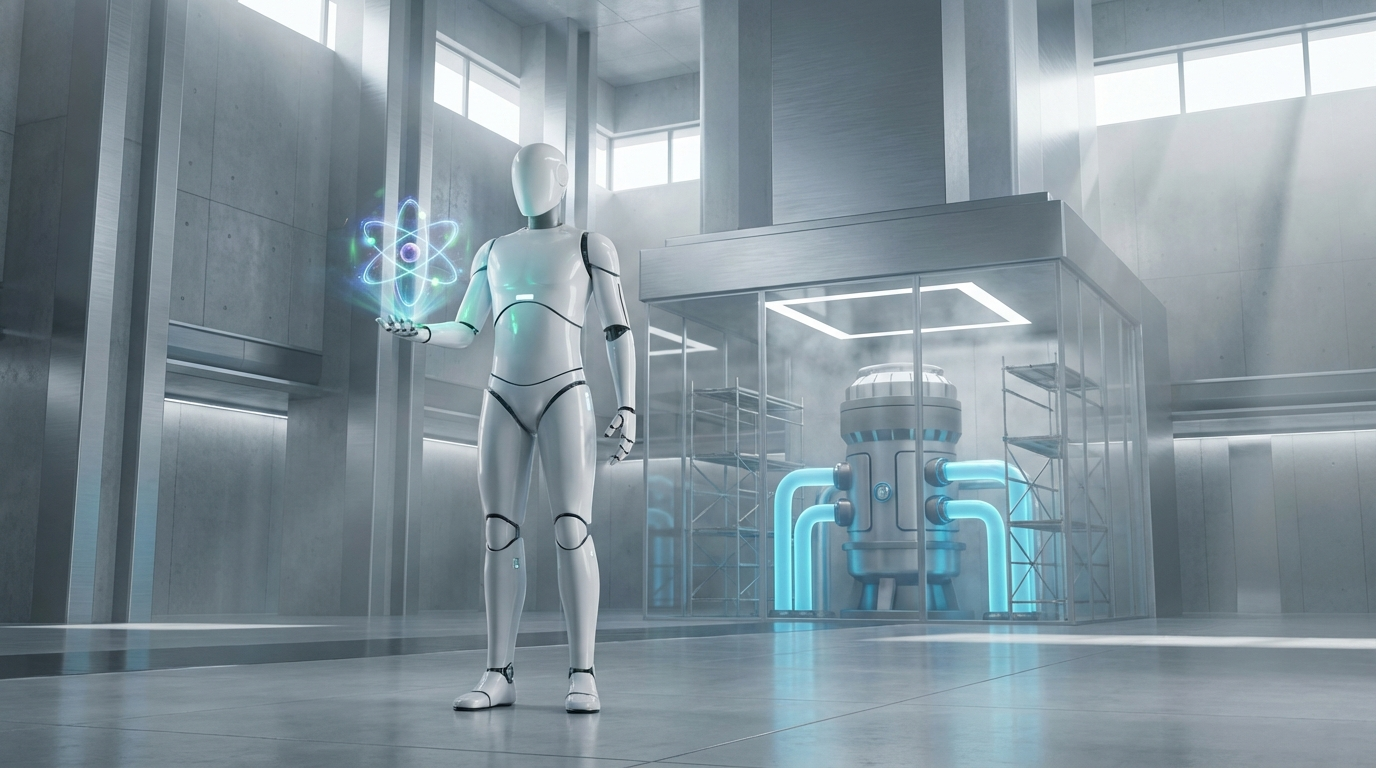
The race for technological supremacy has reached a new physical state: nuclear. What was once a matter of software efficiency has become a battle for megawatts. To ensure energy sovereignty, Big Tech companies are moving away from dependence on civilian power grids, investing billions in next-generation reactors to power not only servers but also the factories that will produce the next global workforce: humanoid robots.
The Nuclear Renaissance: Concrete Facts and Alliances
The movement is not theoretical; it is contractual. Microsoft sealed a landmark deal with Constellation Energy to restart the Three Mile Island reactor (Unit 1), securing exclusive power for its data centers for 20 years. Almost simultaneously, Google announced a partnership with Kairos Power to deploy a fleet of Small Modular Reactors (SMRs), aiming to bring the first online by 2030. Not to be outdone, Amazon invested over $500 million in X-energy to develop SMR technology in Washington state.
Energy sovereignty has become the watchword because the current scale of training models like GPT-5 and its successors requires a load stability that wind and solar — due to their intermittent nature — cannot yet provide without massive storage systems.
The Future Society Perspective: From Data Cathedrals to Factories of Beings
Historically, human progress has always been limited by energy density—from wood to coal, and coal to oil. Today, we are living through a parallel to the Belle Époque, where the electrification of cities enabled the rise of modern industry. However, the contrast this time is that electrification is private and ultra-specialized.
The Revolution in Humanoid Robotics
The expansion of energy sovereignty enables a crucial byproduct: the feasibility of humanoid robot fleets. Companies like Tesla (Optimus) and Figure AI depend on generative AI training infrastructures to teach robots how to navigate the physical world.
- Heavy Industries: SMRs installed directly at industrial hubs will allow auto plants or logistics centers to operate thousands of humanoid robots 24/7 without straining the local grid.
- High-Density Charging: Nuclear energy provides the necessary density for ultra-fast charging stations, where a robot’s battery life can be restored in minutes, keeping industrial productivity constant.
SMRs: The Modularity of Expansion
Unlike the massive nuclear plants of the 20th century, SMRs function like “long-life batteries” that can be installed near where the power is consumed. This modularity allows the technology to expand into regions previously uninhabitable for high-tech, creating new Silicon Valleys in locations that are geographically strategic but energy-isolated.
The Leap Toward Total Autonomy
In the coming years, we will see total vertical integration. A company will not only own the software (AI) and the hardware (Robots) but also its own energy source (SMR). This eliminates the geopolitical risk of energy price fluctuations and ensures that the evolution of intelligence is not hindered by external crises.
We are building a civilization where intelligence is abundant, but energy is the new gold. If energy sovereignty becomes a private asset of the world’s largest corporations, how will developing nations compete in the robotics race?
Additional Fact-Checking (Humanoid Robotics)
While the direct application of SMRs inside humanoid robots is not yet feasible (due to the size of the reactors), the technical viability mentioned in the article refers to powering the charging and training infrastructure (Edge Computing). Companies like Tesla already use supercomputers (Dojo) to train Optimus, and it is this “brain” that is being connected to these nuclear sources to ensure the expansion of the fleet.
Official References
Microsoft & Constellation Energy – Restart of Three Mile Island / Crane Clean Energy Center
Learn more
Google & Kairos Power – First Corporate SMR Agreement
Learn more
Amazon & X-energy – Investment in Next-Gen Nuclear (SMRs)
Learn more
Gartner – Forecast of AI Data Center Power Shortages by 2027
Learn more
IEA (International Energy Agency) – Electricity & Power Sector Outlook / Reports
Learn more. (IEA official report page with forecasts and data related to electricity supply, including projections through 2026)