


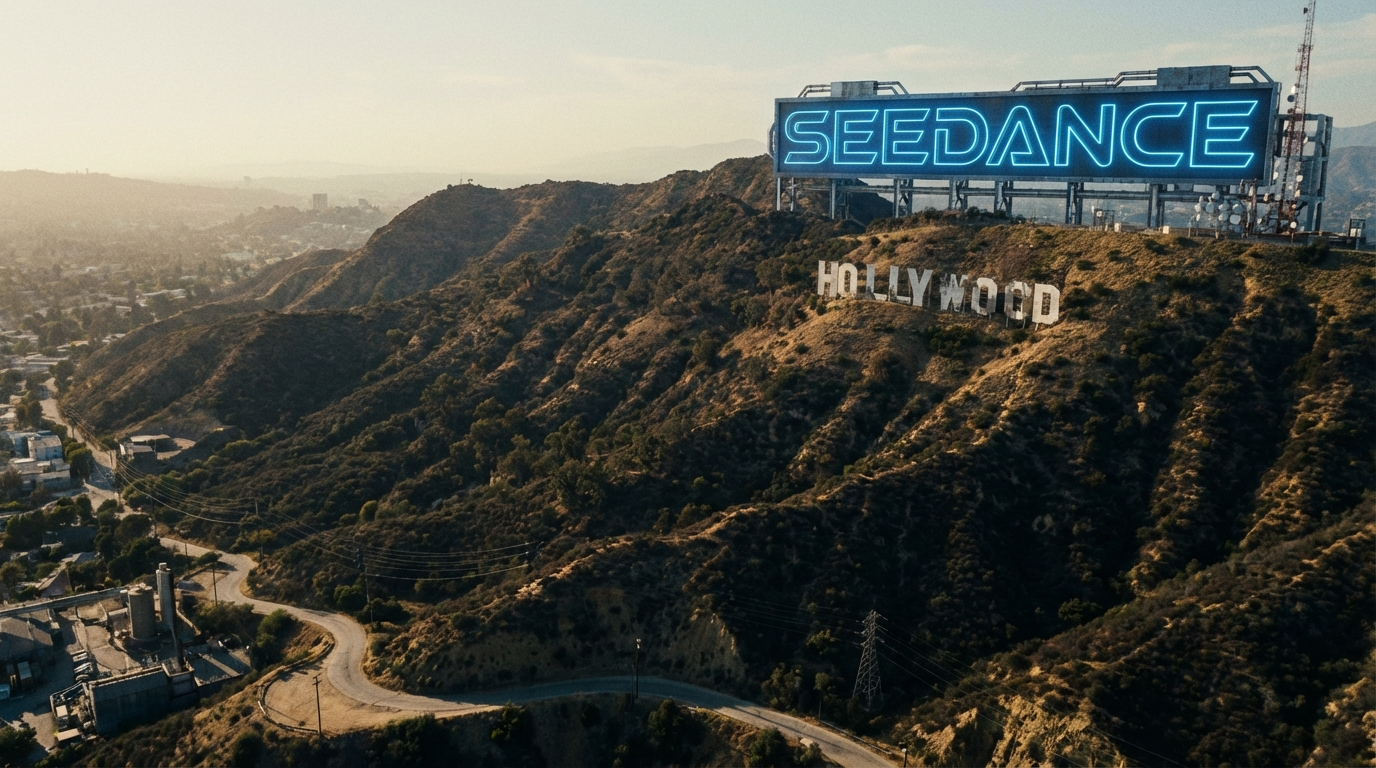
The Great Illusion of "Artistic Death"
For the past two years, the headlines have been a chorus of doom: “AI is killing the artist,” “The end of human creativity,” “The death of cinema.” They are wrong. AI isn’t killing art; it’s killing gatekeepers.
What we are witnessing with the launch of SeeDance 2.0 is the demolition of the $200 million “moat” that has protected the elite entertainment industry for a century.
The “monopólio do entretenimento” ended this morning, and if you haven’t realized it yet, you’re looking at the wrong side of the screen. This isn’t just a software update — it’s a declaration of independence for the global imagination.
Pillar 1: The Technical Translation (Breaking the Render Farm)
To understand why Hollywood is terrified, you have to understand the economic gatekeeping of technology.
In the old world, high-fidelity cinema was a game of raw capital. If you wanted to create a scene with perfect fluid dynamics, realistic motion transfer, or cinematic consistency, you needed two things: Time and Power. You needed “Render Farms” — massive warehouses of servers in cold climates — and a literal army of VFX artists.
SeeDance 2.0 has turned those warehouses into a browser tab. By utilizing neural motion-transfer and predictive temporal consistency, it allows a creator in a favela, a rural village, or a suburban bedroom to generate visuals that rival a Marvel B-unit production. The “Muro de Vidro” (Glass Wall) of technical complexity hasn’t just been lowered; it has been shattered. We have moved from US$ 200M productions to US$ 200 subscriptions.
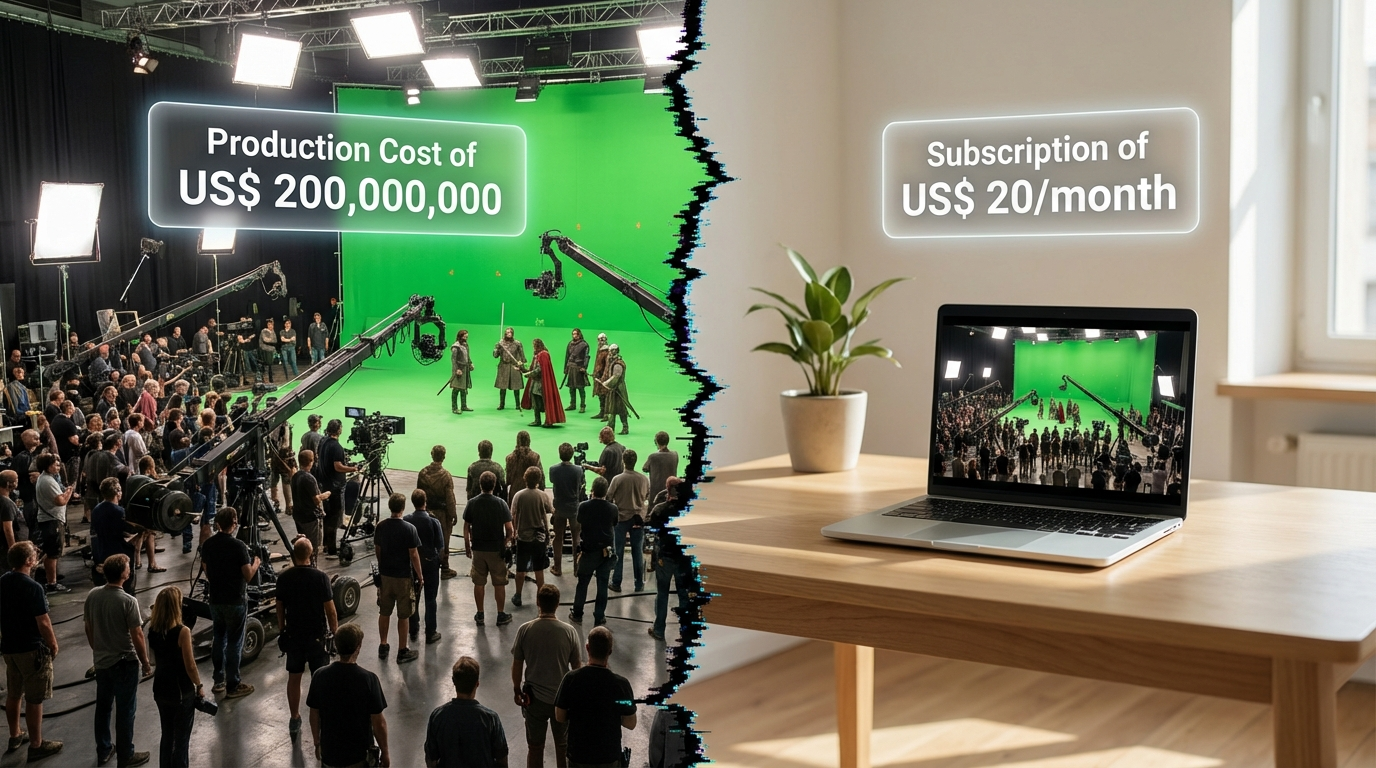
Pillar 2: The Economic Transfer (The End of the Studio Moat)
Let’s talk about the cold, hard numbers of the “Transferência de Riqueza.”
For nearly 100 years, “Quality” was synonymous with “Capital.” If you didn’t have the backing of a major studio, your vision was physically impossible to realize. This created an intellectual poverty where the same 500 people in Burbank decided what stories the entire world got to consume.
With tools like SeeDance 2.0, the “Sovereign Creator” emerges. When the cost of production drops to near zero, the billions of dollars currently locked inside the “Studio System” will begin to bleed out. Why would a visionary director spend three years begging for a studio greenlight when they can produce their epic independently? This is the decentralization of culture — moving wealth from centralized corporate boardrooms to the periferia global.
Pillar 3: The Ethical Death of Gatekeeping
The most frequent argument against this shift is “Curadoria” (Curatorship). Critics ask: “If everyone can make a movie, won’t we be drowned in trash? Won’t we miss the ‘quality control’ of the big studios?”
My provocative answer: What quality control? Look at the last five years of blockbusters. We have been trapped in a cycle of recycled IP, soulless sequels, and “safe” corporate products. Hollywood is currently an intellectual desert.
The “death of the gatekeeper” is an ethical necessity. It allows for:
Cultural Authenticity: Stories from cultures that Hollywood refuses to understand.
Radical Experimentation: Visual styles that are too “risky” for a $200M budget.
The Democratization of Talent: An Oscar-winning mind born in a place without a film school finally has the tools to compete.
Pillar 4: The Dark Vision (The Prophet’s Warning)
But let’s not be blinded by techno-optimism. As a “Profeta Sombrio,” I must warn you: Freedom is not without its chains.
While we escape the monopoly of the Studio Head, we are entering the era of the Algorithm War. In a world of “Infinite Content,” the human creator may become a slave to the “Clique.” If the AI can generate anything, the temptation will be to generate only what the machine knows will trigger a dopamine response.
The danger is that we trade Corporate Censorship for Algorithmic Homogenization. Will the “cineasta independente” use SeeDance 2.0 to expand the human spirit, or will they use it to create 24/7 “slop” designed to keep eyes glued to a feed?
The Conclusion: Adapt or Evaporate
The “Funeral de Hollywood” will be rendered in 60fps, and it will be beautiful. The industry is being forced out of its “zona de conforto monopolista.” They will have to stop relying on their budgets and start relying on their creativity — if they have any left.
We are entering the Golden Age of the Sovereign Creator. The tools of the elite are now the toys of the masses. The only thing standing between you and a cinematic masterpiece is no longer a checkbook — it’s the limits of your own imagination.
The walls are down. What are you going to build?
Editorial Citation
Christensen, Clayton M. (1997). The Innovator’s Dilemma: When New Technologies Cause Great Firms to Fail. Harvard Business Review Press.
Goldman Sachs (2023). AI investment forecast to approach $200 billion globally by 2025.
Benjamin, Walter (1936). The Work of Art in the Age of Mechanical Reproduction.
Jenkins, Henry (2006). Convergence Culture: Where Old and New Media Collide. NYU Press. Additional academic discussion.
IEEE Standards Association (2024). Ethical Guidelines for Synthetic Media and Motion Transfer Technology. IEEE Standards Association.