


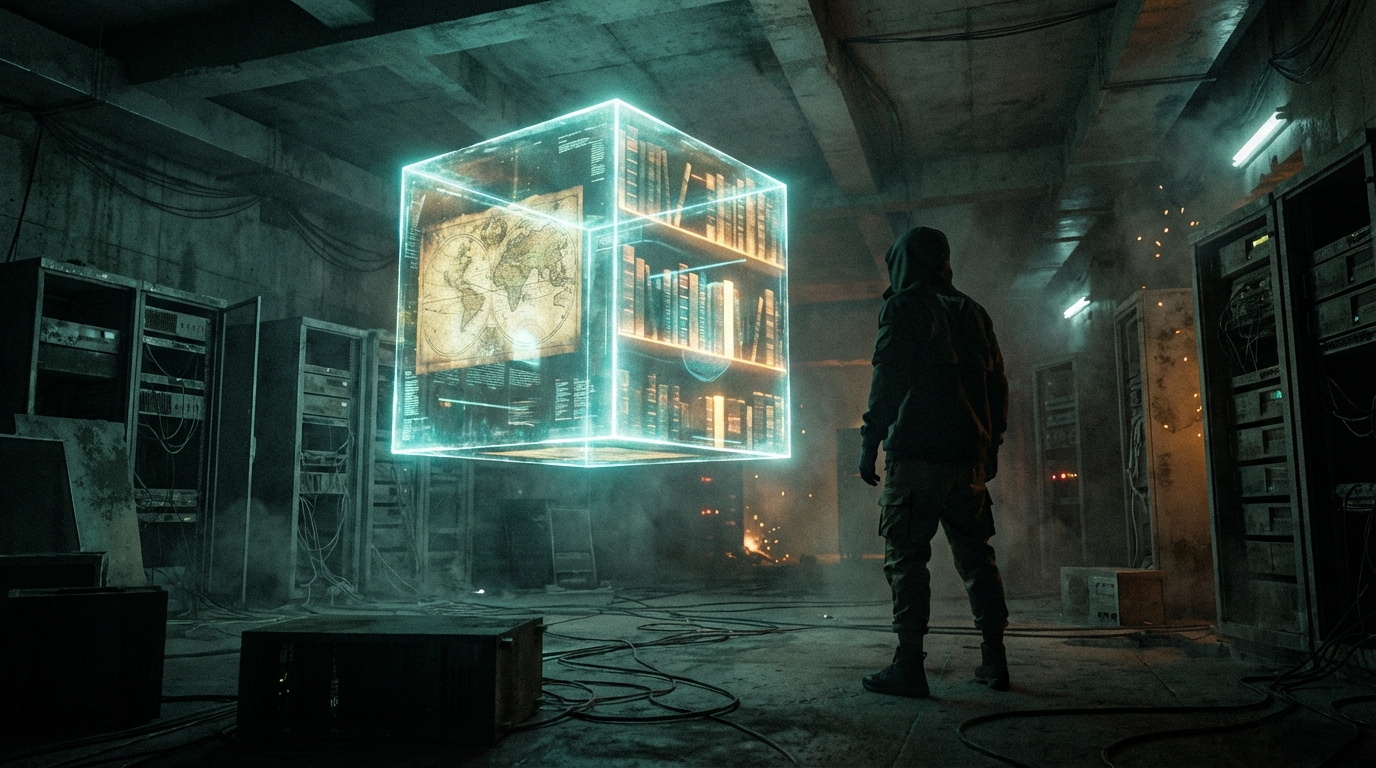
The collapse of global connectivity in 2026 is no longer a fringe conspiracy, but a systemic vulnerability documented by subsea cable failures and escalating cyber warfare. Building a personal “Knowledge Ark” involves decentralizing critical data onto resilient hardware — local servers and Mesh networks — ensuring access to survival manuals, maps, and financial records without reliance on the cloud.
Blind trust in “The Cloud” has become the greatest single point of failure in modern civilization. In 2026, digital infrastructure is a house of cards subject to geopolitical winds and solar storms. If the signal drops today and doesn’t return for 30 days, 90% of your problem-solving capacity vanishes with Google. Digital sovereignty is now measured in terabytes stored locally, not in fiber-optic speeds.
Why "The Cloud" became the ultimate security risk of 2026
Centralizing data within Big Tech servers has created a paralyzing dependency; without a connection, individuals lose digital identity, financial history, and basic functional manuals. The Cloud is effectively just someone else’s computer that can be toggled off by decree or cyber attack.
The sociology of hyper-connectivity has blinded us to the physical fragility of bits. What we call “the internet” is a network of vulnerable cables and data centers consuming power from unstable electric grids.
In 2026, with the rise of autonomous AI capable of orchestrating continental-scale DDoS attacks, the question is not “if” the network will fail, but “when.” Keeping medical records, identity documents, and survival blueprints exclusively online is an act of civil negligence. The shift to an “Offline-First” model isn’t Luddism; it’s survival engineering.
Engineering a Resilient Digital Survival Kit
A digital survival kit requires EMP-protected hardware, high-density storage (SSDs), and offline indexing software like Kiwix. Priority must be given to technical utility: topographic maps, medical encyclopedias, and infrastructure repair guides.
To make your Knowledge Ark functional, you must prioritize information density over entertainment. Consider the following hierarchy for your physical backup:
| Category | Essential Content | Tools / Format |
|---|---|---|
| Medical Sovereignty | Emergency surgery manuals, herbal medicine guides, basic pharmacology. | Encrypted PDFs / Kiwix (.ZIM) |
| Infrastructure | Mechanical repair manuals, generator wiring diagrams, water purification. | Offline Wiki Repositories |
| Critical Data | Crypto-wallets (cold storage), bank statements, deeds, and IDs. | Encrypted Drives (VeraCrypt) |
| Navigation | Detailed regional topographic maps and offline GPS data. | OpenStreetMap (OSMAnd+) |
Mesh Networks and Local Servers: Internet without ISPs?
Mesh networks allow direct device-to-device communication via radio or Bluetooth, bypassing the need for Internet Service Providers (ISPs). Local servers, such as a Raspberry Pi running FreedomBox, transform your home into an autonomous information node.
True digital sovereignty in a “Grid-Down” scenario resides in the ability to create local networks. Protocols like LoRaWAN and hardware like Meshtastic allow for text messaging and GPS coordinate sharing over miles without a single active cell tower. By configuring a low-power local server, you ensure that even if the global backbone is severed, your immediate community retains access to a digital Library of Alexandria. The future will not be streamed; it will be stored on solid-state drives inside copper-lined ammo cans.
Checklist: Cyber Attack and Grid Collapse Preparedness
Download Wikipedia: Use the Kiwix project to download the full version (with or without images) in .ZIM format.
Faraday Protection: Store a low-power tablet and your backup drives in a Faraday bag to protect against Electromagnetic Pulses (EMP).
Portable Solar Power: Maintain small solar panels and LiFePO4 power banks to keep your hardware alive indefinitely.
Offline Maps: Download your entire state and neighboring regions on OpenStreetMap for hardware-based GPS use.
Knowledge Ark: Technical Intelligence Briefing
1. Can a cyber attack actually take down the internet permanently?
A permanent global blackout is unlikely, but regional outages lasting weeks or months are technically feasible through BGP hijacking or physical infrastructure sabotage. Preparation focuses on the “extended temporary blackout.”
2. What is the best hardware for storing a Knowledge Ark?
High-endurance SSDs and industrial-grade SD cards are ideal due to their low power consumption and lack of moving parts. Avoid mechanical HDDs, which are highly susceptible to physical shock.
3. How do I secure my financial data if the network goes dark?
Keep offline, air-gapped versions of recent bank statements, insurance contracts, and cryptocurrency private keys. In the event of a SWIFT system failure, local possession of records is your only proof of assets.
4. Where can I legally download technical manuals?
The Appropedia site and the Survivor Library offer thousands of open-source manuals on appropriate technology, agriculture, and medicine for free download.
Academic References & Further Reading
Mosco, V. (2014). To the Cloud: Big Data in a Turbulent World. Paradigm Publishers.
Perrow, C. (1999). Normal Accidents: Living with High-Risk Technologies. Princeton University Press.
Rushkoff, D. (2010). Program or Be Programmed: Ten Commands for a Digital Age. OR Books.