


There is a conversation happening around you right now. Something that thinks. That feels. That plans. And yet, for the entirety of human history, you have been deaf to it.
But the era of human isolation is drawing to a violent close. As you read this, the barrier of silence that has protected our species’ conscience for millennia is being dismantled — not by spiritual awakening, but by cold, hard silicon. Artificial Intelligence is learning to speak “Nature,” and when the translation is complete, our reality will never be the same.
The Coming Rupture: Dr. Dolittle Meets Big Data
For the first time in history, we are on the precipice of interpreting animal communication at scale. This isn’t science fiction or the whimsical ramblings of a parrot trainer. This is multimodal artificial intelligence analyzing sounds, gestures, and environmental contexts to build semantic maps of non-human intent.
Initiatives like the Earth Species Project and Project CETI (Cetacean Translation Initiative) are no longer just recording sounds; they are decoding the first non-human languages.
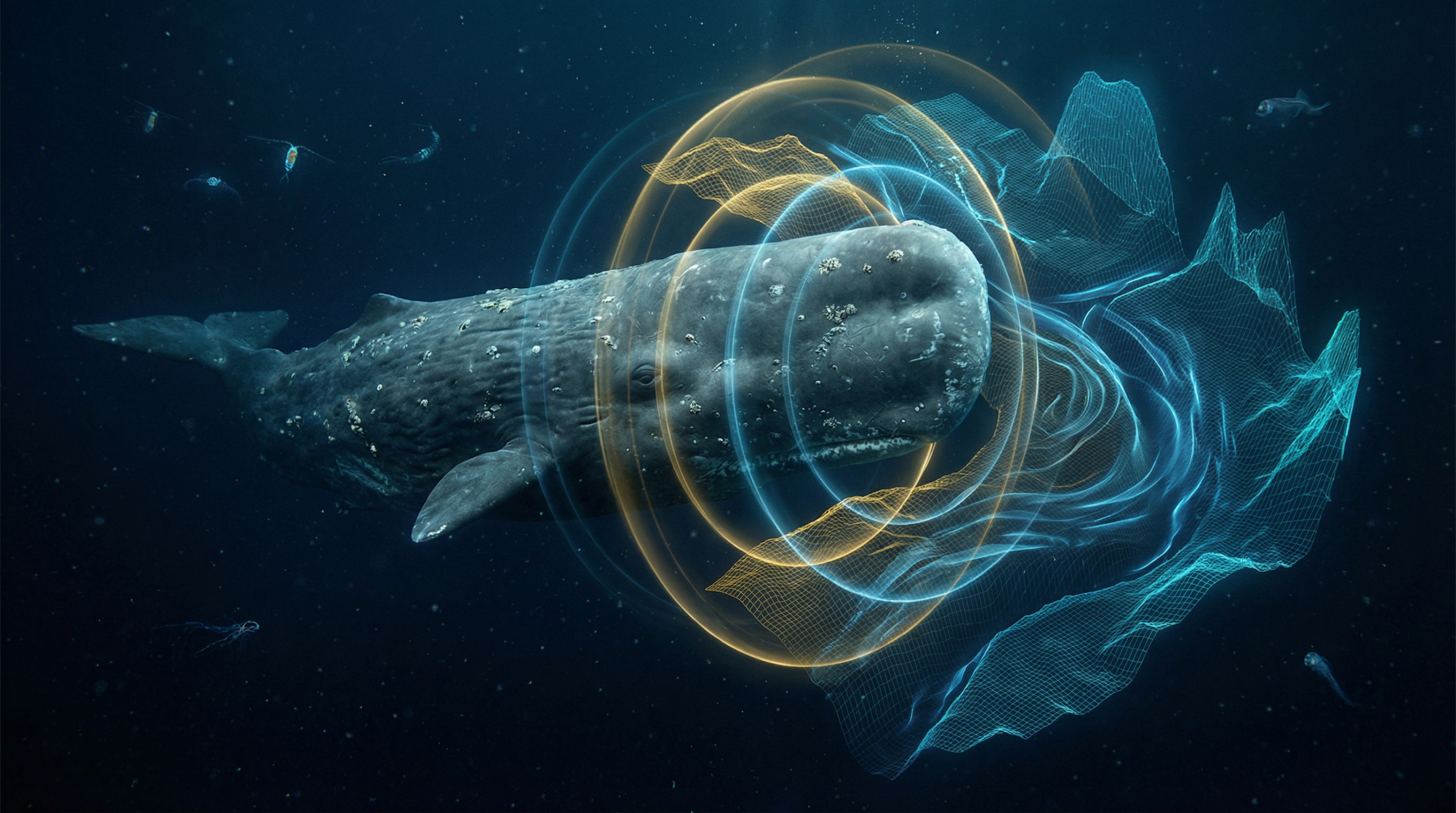
How the Machine Learns to Speak “Whale”
The process is clinical and relentless:
- Massive Data Ingestion: Models are trained on decades of humpback vocalizations, canine barks, and avian melodies.
- Pattern Recognition: AI identifies the “phonemes” of the wild—sounds that consistently precede an attack, a gathering, or a mating ritual.
- Contextual Cross-Referencing: By layering audio with video and environmental data, the AI realizes a growl in the shade isn’t the same as a growl at a watering hole.
Context is the ultimate cipher. Until recently, we lacked the raw computational power to process this complexity. Now, the next five years promise a shift from theory to applied reality.
The Turning Point: Be Careful What You Wish For
Imagine knowing — not guessing — precisely when your dog feels anxiety or love. Imagine a final goodbye where your cat’s subtle expressions are translated into a literal, devastating farewell. It sounds magical, doesn’t it?
But technology is a double-edged sword.
The same algorithm that lets you bond with your pet will force you to hear the things you’ve spent a lifetime ignoring.
The Golden Cage: That bird song you find so “beautiful”? The AI might reveal it as a desperate lament for a sky it will never touch.
The Stray’s Burden: Your phone might translate the raw, factual depth of a stray dog’s hunger and abandonment.
The Brutality of the Wild: A walk in the forest will no longer be “peaceful.” You will hear the tactical coordination of a pack siege and the raw panic of prey.
When you can truly hear, you can no longer pretend you didn’t listen.
The New Scientific Informants
Beyond the emotional weight lies a scientific revolution. We are gaining scientific informants. Whales can tell us about migratory routes no satellite has mapped. Polar bears can report on Arctic transformation in real-time from places humans cannot survive.
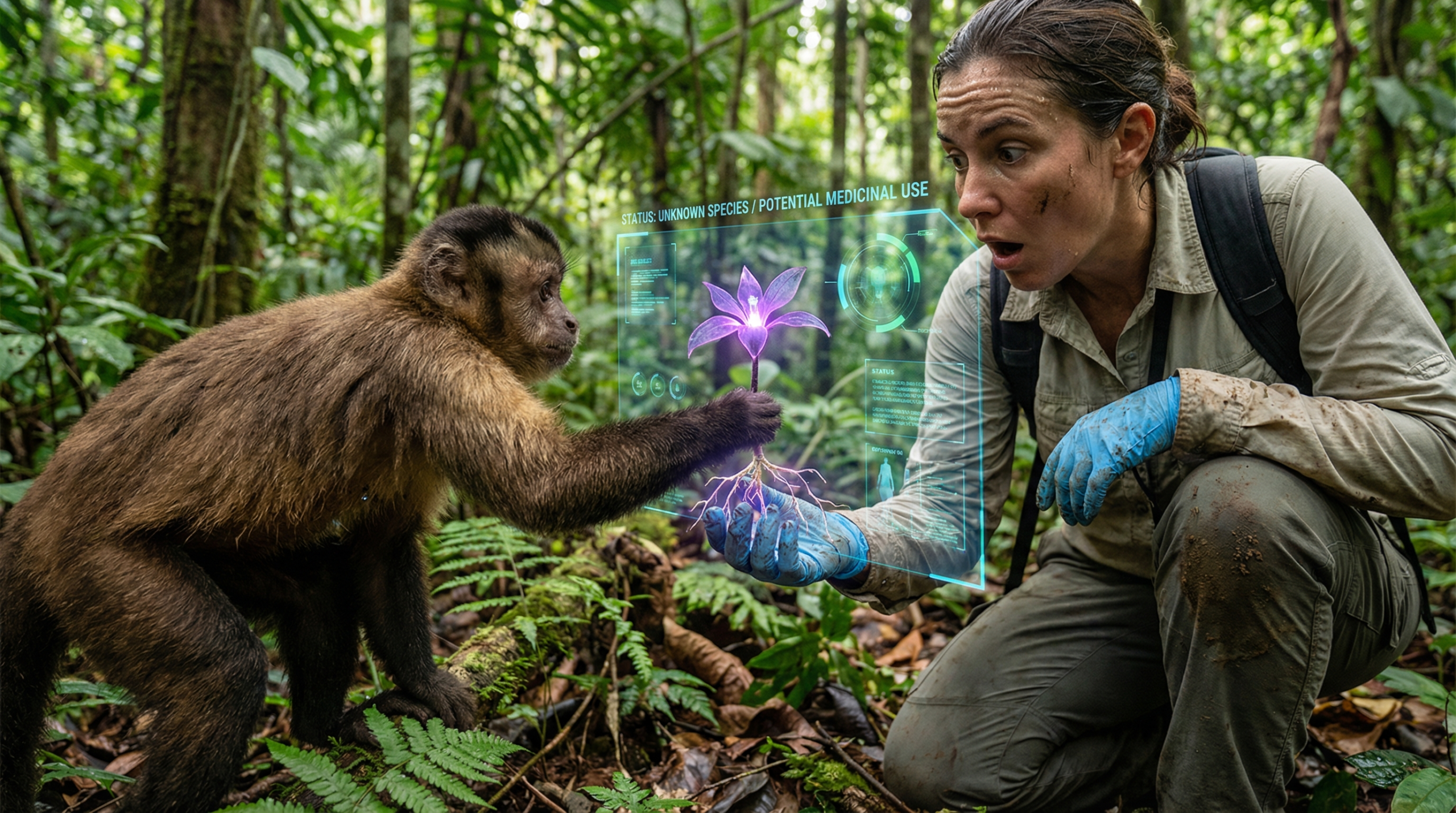
We may find that their “primitive” languages are actually more efficient than ours — conveying topography, danger, and sustenance in a single, complex burst of frequency. How many years of pharmaceutical research could we skip if primates simply pointed us to the plants they use to treat infections?
The Ethical Bomb: Is the Meat Industry Legally Dead?
Here is the point that the industry is terrified to discuss: What happens to our “property” when the property starts talking back?
If a cow can argue, is she still food? If a pig expresses fear of the slaughterhouse in decoded, factual terms, is he still a product?
This isn’t just a moral dilemma; it is a legal catastrophe. The concept of property relies on the “silence” of the owned. Once technology removes the possibility of ignorance, it also removes the possibility of innocence. We once justified keeping humans as property through pseudoscientific theories of inferiority. We are about to face that same mirror, but this time, the reflection has fur and feathers.
Intelligent Life in the Backyard
We spend billions scanning distant galaxies for a “hello” from the stars, yet we have been surrounded by intelligent life since our inception. Our arrogance has been our earplugs.
We demanded that other beings prove their intelligence by our standards, failing to realize that we were the ones failing the test of comprehension. AI is finally giving us the humility to listen.
The Moral Silence
We are on the threshold of a redefinition of the human identity. When you can converse with another form of life, your place in the world shifts from “Master” to “Neighbor.”
Some will dismiss this as anthropomorphism or “AI fluff.” But technology doesn’t care about your skepticism. It is moving forward.
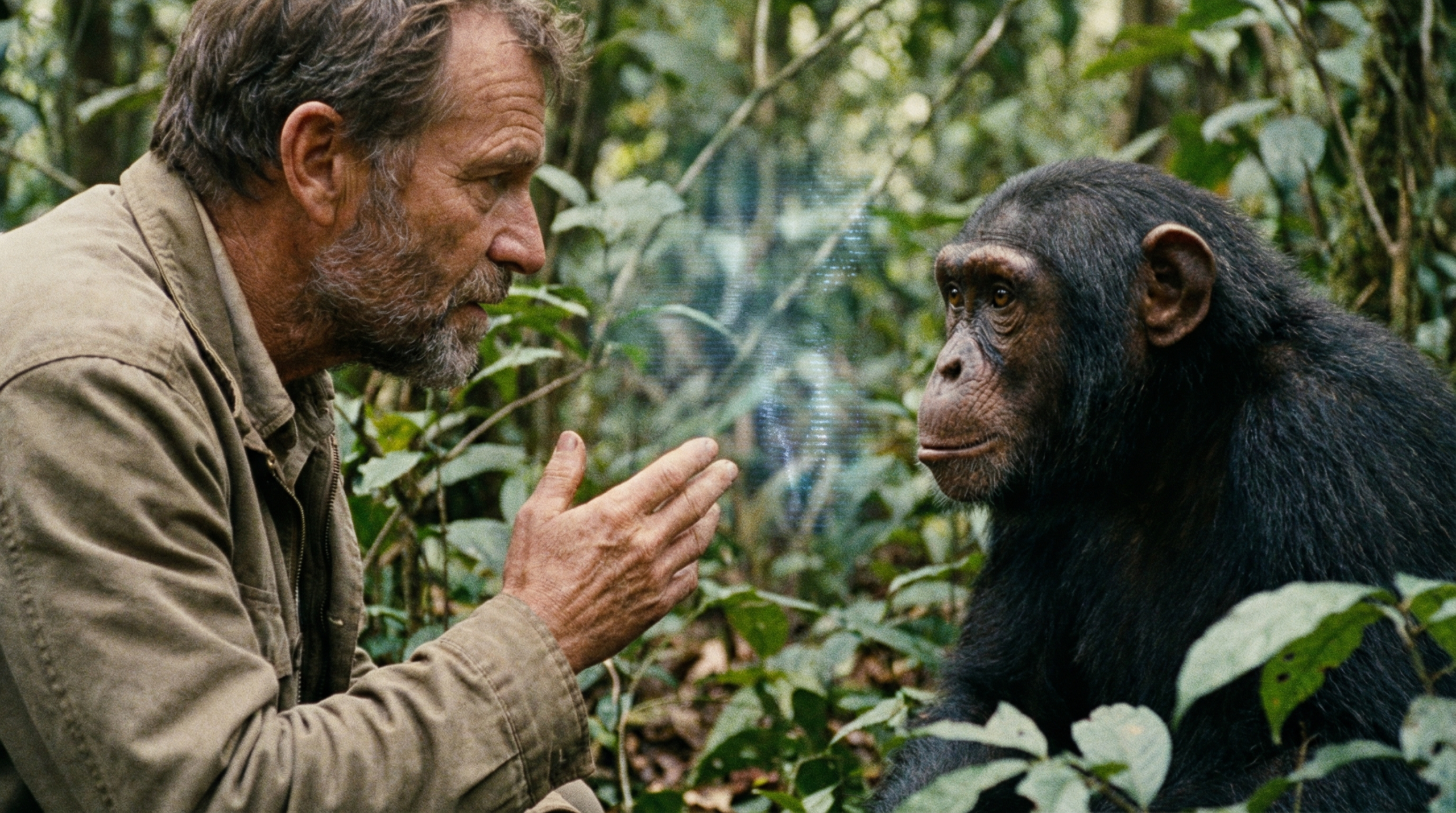
Picture this: A human and an animal standing in a field. No leash, no cage, no dominance. Just a small device between them. When the translation finally clears the air, the silence that follows won’t be technological — it will be moral.
When we finally hear what they have to say, will we like what we hear about ourselves?
Academic References & Citations
1. Bermant, P. C., Bronstein, M. M., Wood, R. J., Gero, S., & Gruber, D. F. (2019). Deep Machine Learning for Marine Mammal Acoustics: Methods and Applications. Journal of Marine Science and Engineering. This foundational paper outlines how Deep Learning (DL) is moving from simple detection to the actual classification of complex “codas” in sperm whales. Access via MDPI Open Access
2. Rutz, C., Loretto, M. C., Bates, L. A., Davidson, S. C., Duarte, C. M., Jetz, W., … & Mueller, T. (2020). COVID-19 lockdown allows researchers to quantify the effects of human activity on wildlife. Nature Ecology & Evolution. While focused on the “anthropause,” this study highlights the massive scale of bio-logging and the global data networks now available to AI models.
3. Andreas, J., Andreas, G. K., & Levin, S. A. (2022). Toward Understanding the Communication of Other Species. Earth Species Project (White Paper). This technical roadmap details the use of Self-Supervised Learning (SSL) to find patterns in animal vocalizations without needing a “Rosetta Stone” (human labels). Read the Research at Earth Species Project
4. Grimm, D. (2021). Are animals people? The legal battle over animal personhood. Science. This article tracks the shift in the US legal system regarding the “habeas corpus” for non-human primates and cetaceans.
5. Allen, C., & Trestman, M. (2020). Animal Consciousness. The Stanford Encyclopedia of Philosophy. A rigorous philosophical framework exploring the “Cambridge Declaration on Consciousness,” which provides the ethical grounding for your “Act V” regarding human arrogance and recognition of intelligence.