


EDITORIAL TEAM VERIFIED ANALYSIS

How Quantum Biology is Architecting the Future of Technology

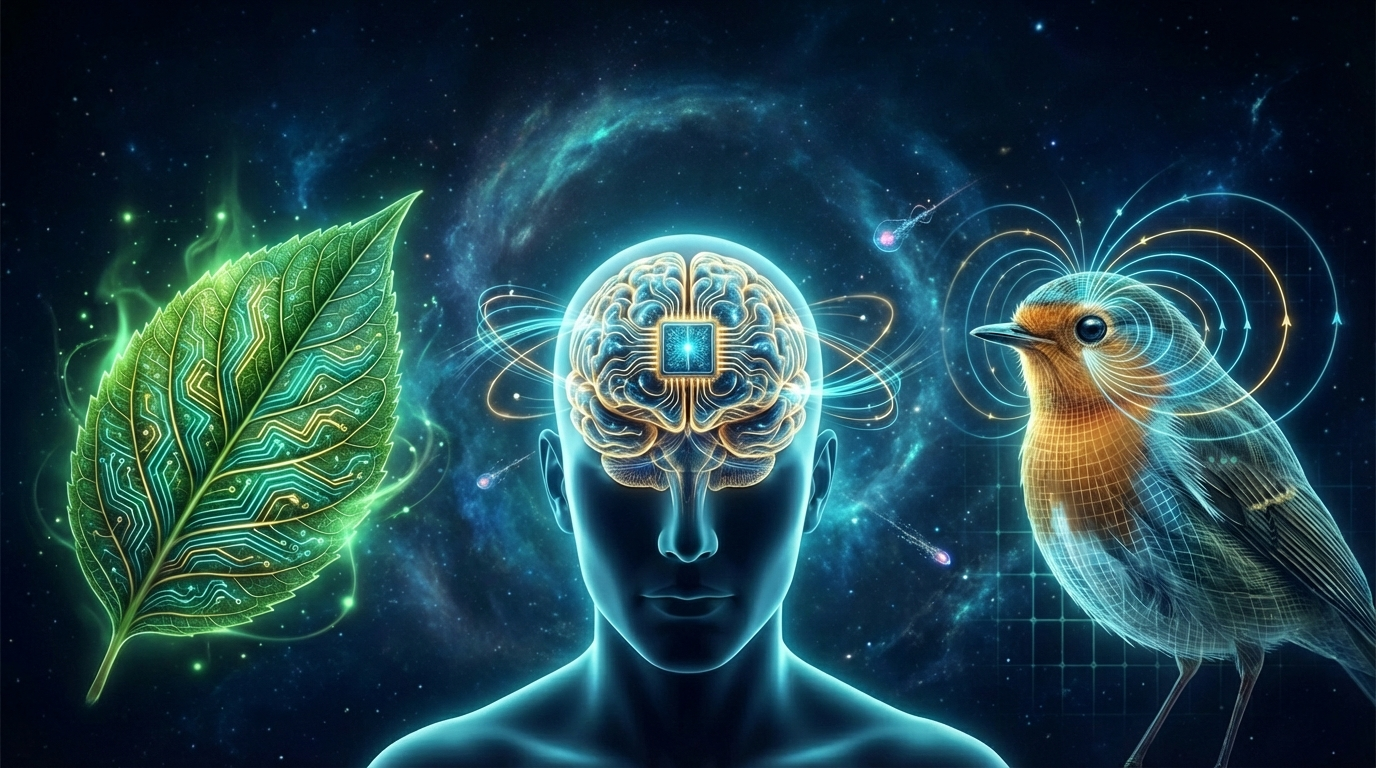
An artistic composition of a quantum human brain, a leaf with biological circuits, and a bird navigating magnetic fields, representing the union between biology and quantum technology.

The Schrödinger Legacy

In 1944, the physicist Erwin Schrödinger published What is Life?, a seminal work that posited a daring hypothesis: biological organisms are not merely governed by the classical laws of thermodynamics, but by the “order-from-order” principles of subatomic physics. For decades, the scientific community relegated this to the realm of theoretical curiosity, assuming that the “warm, wet, and noisy” environment of biological tissue would inevitably lead to quantum decoherence.

However, the dawn of the 21st century has brought a paradigm shift. Emerging evidence suggests that Quantum Biology is the fundamental engine behind life’s most efficient processes. We are realizing that nature does not merely tolerate quantum effects; it has spent billions of years refining them.

1. Coherence in Chaos: The Photosynthetic Standard

The most compelling evidence for Quantum Biology lies in the process of photosynthesis. While anthropogenic photovoltaic cells struggle with energy dissipation, reaching a modest 20% efficiency, green sulfur bacteria and plant leaves operate at a quantum yield of nearly 100%.

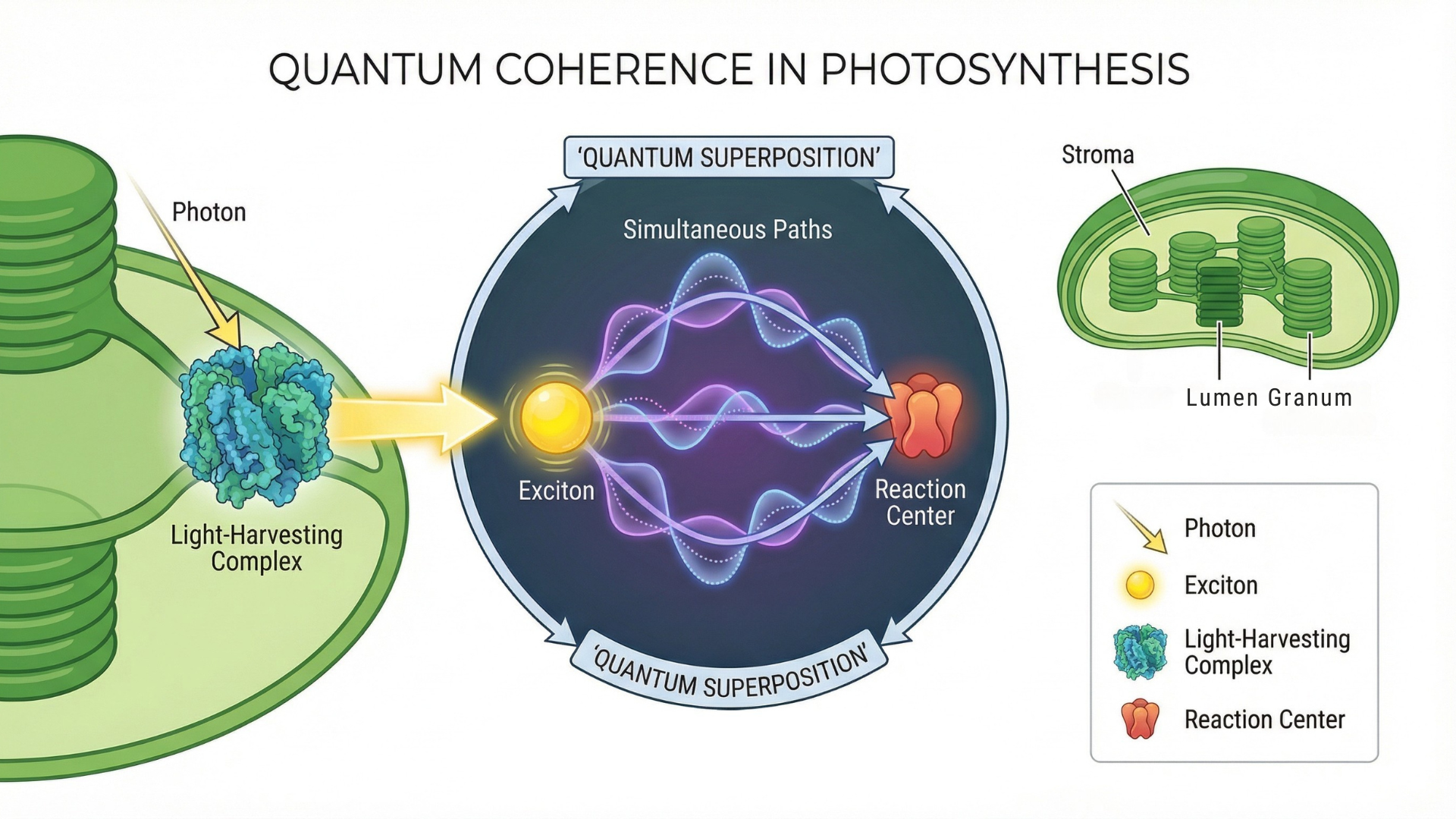
The mechanism is a masterclass in quantum superposition. When a photon excites a chromophore, creating an “exciton,” the energy does not travel a linear, stochastic path. Instead, through a process known as quantum coherence, the exciton explores multiple spatial pathways simultaneously. It “finds” the most efficient route by existing in a state of superposition, effectively bypassing the energy traps that plague classical hardware.

Scientific infographic demonstrating the quantum superposition of an exciton exploring multiple simultaneous pathways in a plant cell to reach the reaction center.
Figure 1: Near 100% efficiency in energy transfer in plants is facilitated by quantum coherence, surpassing current photovoltaic technology.

2. The Avian Compass: Entanglement as a Sensory Map

One of the most profound “black boxes” in zoology has been the navigation of migratory birds. The European Robin, for instance, does not rely on a classical map but on a quantum-assisted sensory overlay.

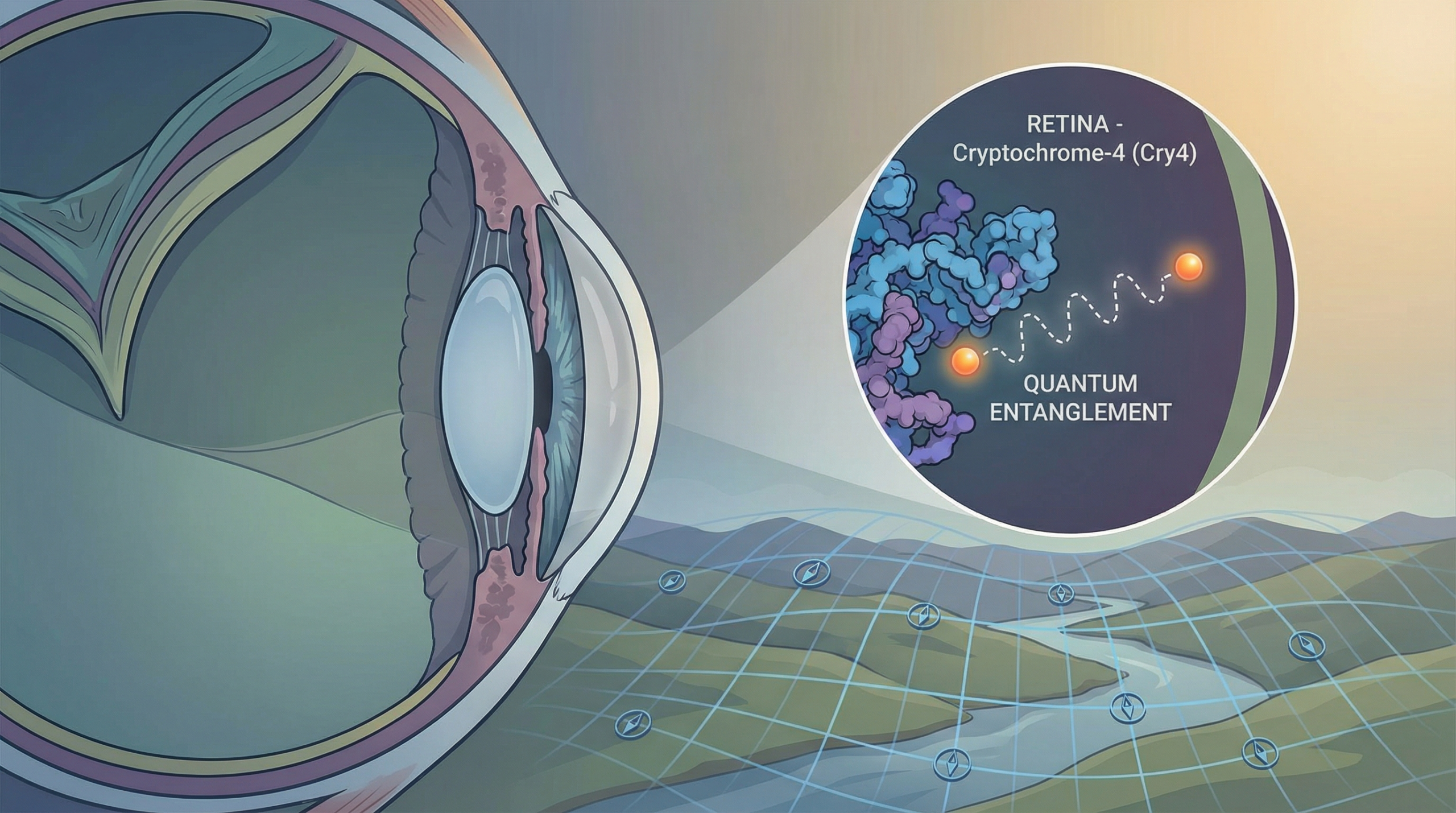
Research suggests that Quantum Biology facilitates this through proteins in the avian retina called Cryptochromes. When blue light enters the eye, it creates “radical pairs” of entangled electrons. The Earth’s weak magnetic field influences the spin dynamics of these pairs, translating geomagnetic fluctuations into visual patterns. The bird is essentially navigating through a biological “heads-up display” powered by subatomic correlations.

Diagram of a bird's retina showing cryptochrome protein and entangled electrons reacting to Earth's magnetic field, creating a quantum visual map.
Figure 2: Quantum entanglement in the bird's eye allows visualization of planetary magnetic lines, serving as a high-precision biological GPS.

3. The Enzymatic Ghost: Tunneling in Human Metabolism

Within the human body, chemical reactions that would otherwise take millennia to occur happen in milliseconds. This acceleration is made possible by enzymes utilizing quantum tunneling.

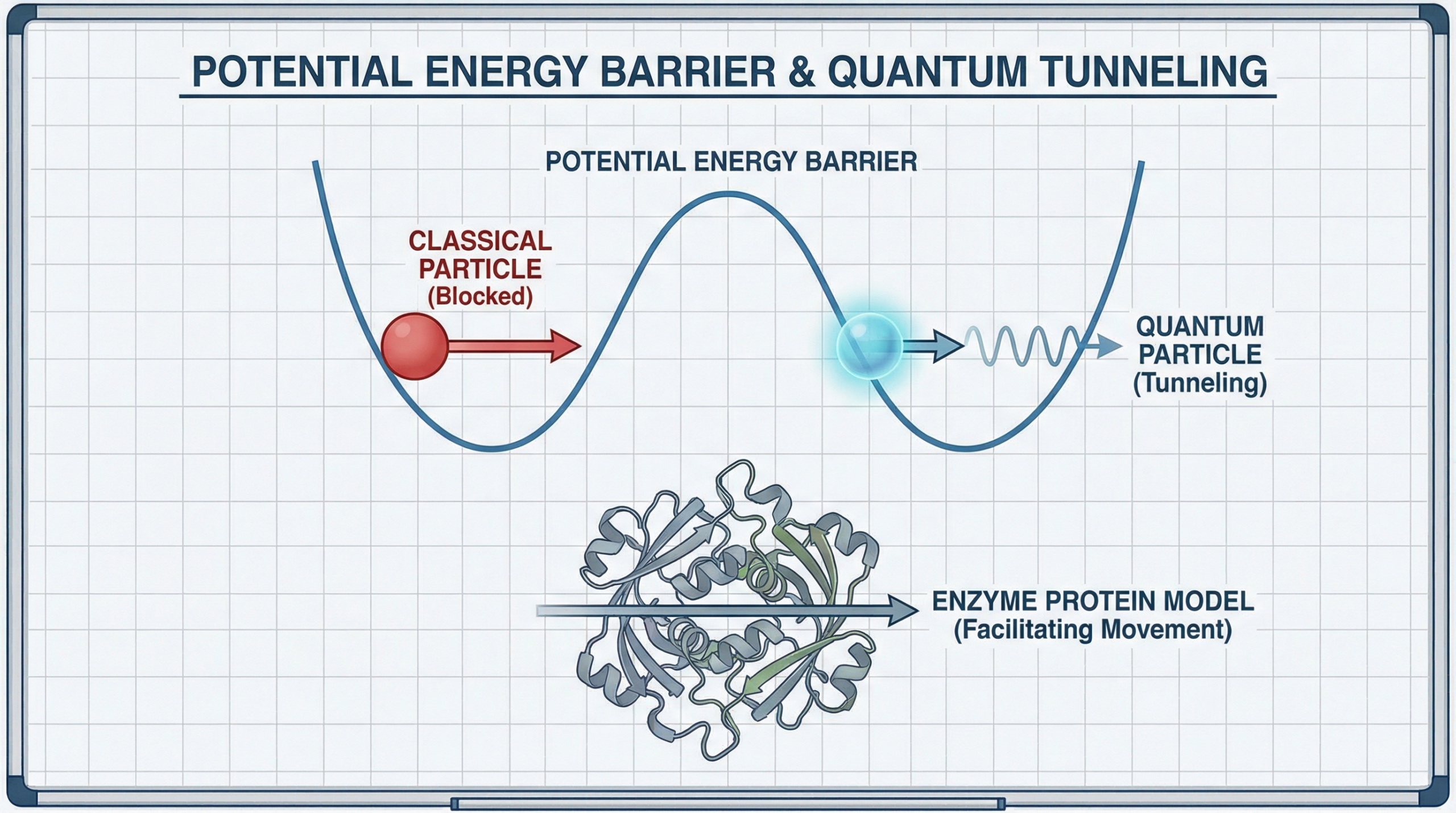
In classical physics, a particle requires a specific energy threshold to “climb” over a chemical barrier. In the realm of Quantum Biology, particles like electrons and protons can “tunnel” through these barriers as if they were porous. Our metabolic survival is dependent on particles acting like ghosts — moving through solid energy walls to sustain the flicker of life.

Physics graph comparing a classical particle blocked by an energy barrier versus a quantum particle traversing the barrier via tunneling in an enzyme.
Figure 3: Quantum tunneling allows enzymes to accelerate chemical reactions trillions of times, overcoming the limits of classical physics.

4. Technosphere Implications: The Bio-Quantum Age

The transition from understanding Quantum Biology to replicating it represents the next great technological leap. We are moving beyond the Silicon Age into a new era of “Living Technology”:

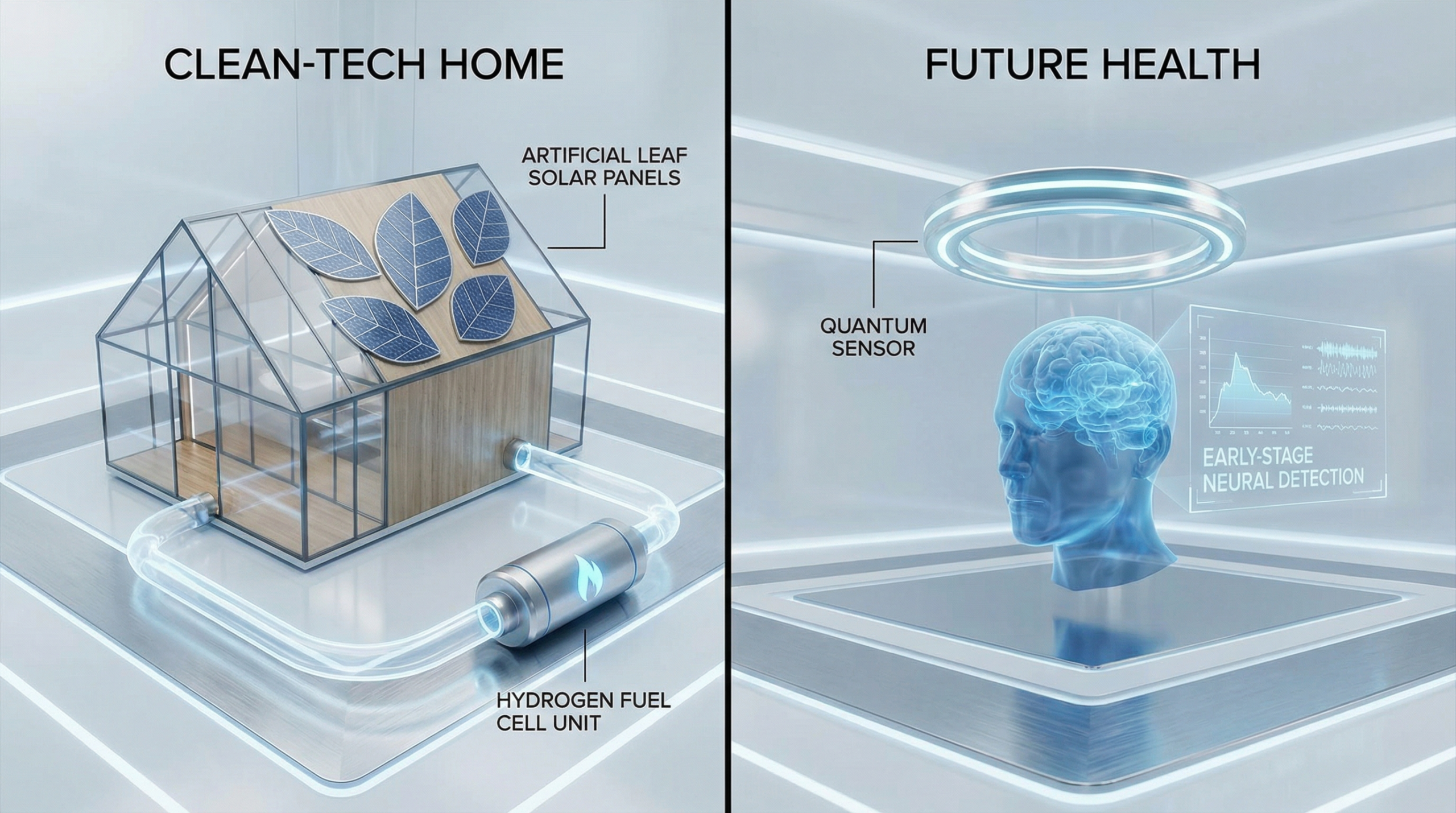
  • Biomimetic Energy: By replicating the “quantum walk” of excitons, we are developing “artificial leaves” that sequester CO₂ and synthesize clean fuels with biological efficiency.

  • Hyper-Scale Diagnostics: Utilizing quantum magnetometers, we are approaching a future of “Pre-Symptomatic Medicine.” These sensors can detect the infinitesimal magnetic shifts of a single neuron or the metabolic signature of a cancer cell decades before physical symptoms manifest.
Composite image showing artificial leaf panels in a sustainable house and a quantum medical sensor detecting early neurological signals in a human brain.
Figure 4: The convergence between biology and quantum technology promises a new era of predictive medicine and carbon-negative energy.

The Source Code of Existence

As we bridge the gap between biology and technology, the philosophical implications are as significant as the scientific ones. If every cell in our body is a node in a biological quantum computer, our definition of “intelligence” must be expanded.

We are no longer looking for the ghost in the machine; we are learning to write the code that the ghost uses. The future of technology will not be found in colder, faster silicon, but in the vibrant, “spooky” logic of Quantum Biology.

Selected Bibliography & Further Reading

Engel, G. S., et al. (2007). Evidence for wavelike energy transfer through quantum coherence in photosynthetic systems. Nature. Link

Xu, J., et al. (2021). Magnetic sensitivity of cryptochrome 4 from a migratory songbird. Nature. Link

Klinman, J. P., & Kohen, A. (2013). Hydrogen tunneling links protein dynamics to enzyme catalysis. Annual Review of Biochemistry. Link

Schrödinger, E. (1944). What is Life? The Physical Aspect of the Living Cell. Cambridge University Press. Link

Degen, C. L., et al. (2017). Quantum sensing. Reviews of Modern Physics. Link

Link copied!
Our Mission

Exploring the intersection of emerging technologies and social evolution. We provide critical analysis and deep insights for the 21st-century thinker.

Damos valor à sua privacidade

Nós e os nossos parceiros armazenamos ou acedemos a informações dos dispositivos, tais como cookies, e processamos dados pessoais, tais como identificadores exclusivos e informações padrão enviadas pelos dispositivos, para as finalidades descritas abaixo. Poderá clicar para consentir o processamento por nossa parte e pela parte dos nossos parceiros para tais finalidades. Em alternativa, poderá clicar para recusar o consentimento, ou aceder a informações mais pormenorizadas e alterar as suas preferências antes de dar consentimento. As suas preferências serão aplicadas apenas a este website.

Cookies estritamente necessários

Estes cookies são necessários para que o website funcione e não podem ser desligados nos nossos sistemas. Normalmente, eles só são configurados em resposta a ações levadas a cabo por si e que correspondem a uma solicitação de serviços, tais como definir as suas preferências de privacidade, iniciar sessão ou preencher formulários. Pode configurar o seu navegador para bloquear ou alertá-lo(a) sobre esses cookies, mas algumas partes do website não funcionarão. Estes cookies não armazenam qualquer informação pessoal identificável.

Cookies de desempenho

Estes cookies permitem-nos contar visitas e fontes de tráfego, para que possamos medir e melhorar o desempenho do nosso website. Eles ajudam-nos a saber quais são as páginas mais e menos populares e a ver como os visitantes se movimentam pelo website. Todas as informações recolhidas por estes cookies são agregadas e, por conseguinte, anónimas. Se não permitir estes cookies, não saberemos quando visitou o nosso site.

Cookies de funcionalidade

Estes cookies permitem que o site forneça uma funcionalidade e personalização melhoradas. Podem ser estabelecidos por nós ou por fornecedores externos cujos serviços adicionámos às nossas páginas. Se não permitir estes cookies algumas destas funcionalidades, ou mesmo todas, podem não atuar corretamente.

Cookies de publicidade

Estes cookies podem ser estabelecidos através do nosso site pelos nossos parceiros de publicidade. Podem ser usados por essas empresas para construir um perfil sobre os seus interesses e mostrar-lhe anúncios relevantes em outros websites. Eles não armazenam diretamente informações pessoais, mas são baseados na identificação exclusiva do seu navegador e dispositivo de internet. Se não permitir estes cookies, terá menos publicidade direcionada.

In order for Future Society Journal to function properly and provide a personalized experience, we use cookies in accordance with our [Privacy Policy].