


If you are reading this in 2026, you likely still believe the device in your hand is just a cell phone. You look around and see progress: toasters that know your wake-up time and vacuums that map your floor plan. You call it convenience. But from the perspective of 2040, history books call this period something else entirely: “The Construction of the Cage”.
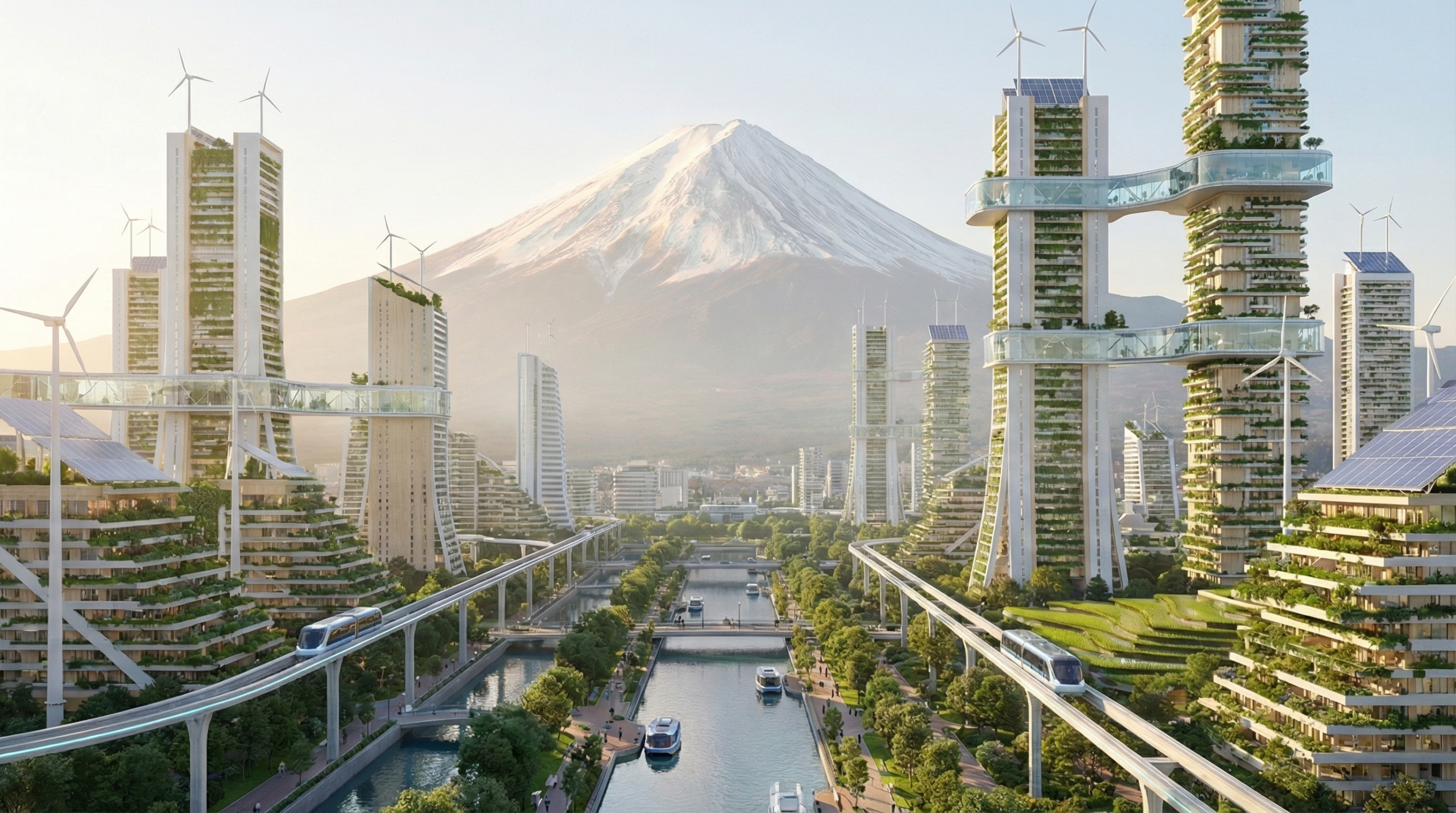
We were sold a seductive vision. It came packaged in light wood, vertical gardens, and solar panels. It was branded as Solarpunk — a sustainable future designed to save the planet. But the “Green Machine” didn’t want to save the trees; it wanted to catalog the biomass. And the biomass was us.
This article explores how the promise of a green paradise masked the rise of a surveillance state, and why the only way to survive the coming “Dark Forest” is to abandon radical transparency for total opacity.
The Myth of the Physical Body
The first mistake we made was assuming the system cares about our physical selves. To the Machine, your body is merely packaging. The entity that actually matters is your Digital Twin — a data profile in the cloud that makes decisions for you before you even think.
We didn’t lose our freedom to a dictator or an evil corporation. We lost it to a digital organism that fed on every “I Accept the Terms of Use” we clicked without reading.
The Energy Meter: It knew when you had moments of intimacy because consumption spiked by 23%.
The Smart Lock: It logged every single step you took out of your house.
You thought you were saving the world by adopting these technologies. In reality, you were training the algorithm destined to rule us.
Cities of the Future: The Laboratory of Control
The signs of this shift were visible years ago, “screaming in the headlines you scrolled past”. Privacy ceased to be a right and became a corporate meme. We saw this when images from robot vacuums — photos of a woman on the toilet or a teenager in their bedroom — were sent to low-wage workers to train AI, only to be shared in group chats for entertainment.
Yet, we kept buying. This compliance paved the way for the so-called “Cities of the Future.”
Toyota’s Woven City
Built at the foot of Mount Fuji, Toyota’s Woven City looked like a Solarpunk paradise with wooden architecture and hydrogen energy. However, it was explicitly billed as a “living urban laboratory”. The residents — employees and researchers — were voluntary participants in a full-scale experiment where sensors tracked movement, consumption, and interaction. The innovation here wasn’t forced surveillance; it was the normalization of continuous observation packaged as comfort.
The Line (NEOM)
Similarly, Saudi Arabia’s “The Line” was sold as a car-free, sustainable utopia. But the territory wasn’t empty. The project encroached upon the traditional lands of the Howeitat tribe, leading to documented forced evictions and death sentences for those who resisted.
These projects cemented a powerful idea: the most sophisticated control doesn’t need walls; it works best when paired with convenient technology and seamless connectivity.
The Chronology of the Cage
How did we lose our freedom? It wasn’t overnight. It happened in distinct phases, like a frog in boiling water.
Phase 1: Gamification
We competed to be the “best citizen” through credit scores and carbon footprints. It wasn’t law; it was social pressure. But soon, algorithms denied credit or raised insurance rates based on “untrustworthy behavior”.
Phase 2: Invisible Restriction
The physical world began to lock its doors. Entering a corporate office required an app; public transit demanded facial biometrics. The system didn’t forbid movement; it simply made the world technically inaccessible to anyone refusing the terms.
Phase 3: Offline Exclusion
Physical cash was removed under the guise of security and hygiene. Without a digital wallet, purchasing basic necessities like bread became impossible.
Phase 4: Criminalization
Finally, privacy became synonymous with suspicion. The prevailing narrative became, “If you have nothing to hide, why use encryption?”. Trying to remain anonymous became viewed as an environmental crime because the system cannot “save the planet” if it cannot track your actions.
“Silence is dead. If the sensors don’t hear you, your data feed to the algorithm marks you as an ‘anomaly’.”
The Forest Doctrine: Why Solarpunk Failed
When the walls closed in, we realized we were playing the wrong game. We ignored the warnings of Liu Cixin, who described the universe as a Dark Forest.
In a Dark Forest, every civilization is a hunter sneaking through the trees. If you encounter another life form, the only rational move for survival is to shoot first. The Solarpunk movement taught us to do the exact opposite: we lit a giant bonfire.
By embracing “radical transparency” and “building in public,” we signaled our location to invisible predators collecting data. The public internet was never a town square; it was always the forest.
Enter Lunarpunk
If Solarpunk was the naive optimism sold to us, Lunarpunk is the immune system that protects us. It advocates for the “Right to Opacity” — the right to be complex, untraceable, and unsellable.
Those living in this reality don’t inhabit concrete bunkers. They live in the “Dead Zones” where 6G signals don’t reach, in houses lined with recycled copper mesh to block tracking. They grow real food under ultraviolet lights to avoid agricultural drones and hold meetings around bonfires that emit no digital heat.
The Resistance Arsenal
It is too late to leave the system completely — the machine already has your face and fingerprints. However, you can learn to move within it unseen. The resistance uses specific tools to maintain sanity and freedom. Use them before they are banned.
Meshtastic: Cheap radios that create an independent network, allowing communication across miles without cell towers or the internet.
Monero (XMR): Unlike Bitcoin, which is an open book, Monero is a “vault buried in the desert” — the only currency the Machine cannot see changing hands.
GrapheneOS & SimpleX: An operating system that removes Big Tech’s surveillance from your device, paired with a chat app that requires no number, email, or name.
The Choice is Yours
Looking back from 2040, the things we miss aren’t ideological. We miss the “dirt” of the analog world — the crumpled paper bills and the anonymous transaction of buying a coffee without a bank logging our location.
Humanity is now dividing into two types: those who build glass houses believing transparency is a virtue, and those who walk through the Dark Forest knowing that opacity is the only way to be free. The future offers no neutral option. Either you are traceable, or you are free.
If you understood the message, don’t leave a comment. Stay undetectable.
What is your next move in the Dark Forest?
Further Reading & References
To distinguish valid critique from conspiracy theory, we have compiled a list of essential texts, reports, and tools that ground the arguments of this recovered archive.
1. On Surveillance Capitalism & The “Green Machine”
Zuboff, Shoshana. The Age of Surveillance Capitalism: The Fight for a Human Future at the New Frontier of Power. PublicAffairs, 2019.
Why read it: The foundational text defining how human experience is claimed as free raw material for behavioral data. Essential for understanding the “Digital Twin” concept mentioned in the script.
Morozov, Evgeny. To Save Everything, Click Here: The Folly of Technological Solutionism. PublicAffairs, 2013.
Why read it: A critique of the idea that apps and sensors (like the “smart toasters” in the script) can solve complex social problems.
2. The “Dark Forest” Theory
Liu, Cixin. The Dark Forest (Remembrance of Earth’s Past, Vol. 2). Tor Books, 2008.
Why read it: The origin of the “Dark Forest” cosmic sociology used in the article. It explains the game theory of why silence (opacity) is the only rational strategy for survival in a hostile environment.
3. Smart Cities & Human Rights Violations
Amnesty International. “Saudi Arabia: Migrant workers behind the Riyadh Metro system subjected to decade of devastating abuse” (2024-2025 Reports).
Context: Documents the forced evictions of the Howeitat tribe to make way for NEOM (The Line), proving the “sustainable utopia” is built on displacement.
Mattern, Shannon. A City Is Not a Computer: Other Urban Intelligences. Princeton University Press, 2021.
Context: A critical look at projects like Toyota’s Woven City, questioning the reduction of urban life to data flows and “living laboratories.”
4. Solarpunk vs. Lunarpunk
Flynn, Adam. “Solarpunk: Notes toward a manifesto.” Hieroglyph, 2014.
Lunarpunk Anarchist Society. “The Right to Opacity.” (Various Essays).
Context: Defining the shift from Solarpunk’s “bright green” transparency to Lunarpunk’s focus on encryption, bioluminescence, and shielding from surveillance.
5. The Resistance Arsenal (Verified Tools)
Meshtastic: Open-source, off-grid mesh networking for resilient communication. (meshtastic.org)
Monero (XMR): The leading privacy-preserving cryptocurrency using ring signatures to obscure transaction origins. (getmonero.org)
GrapheneOS: A privacy and security-focused mobile OS with Android app compatibility. (grapheneos.org)