


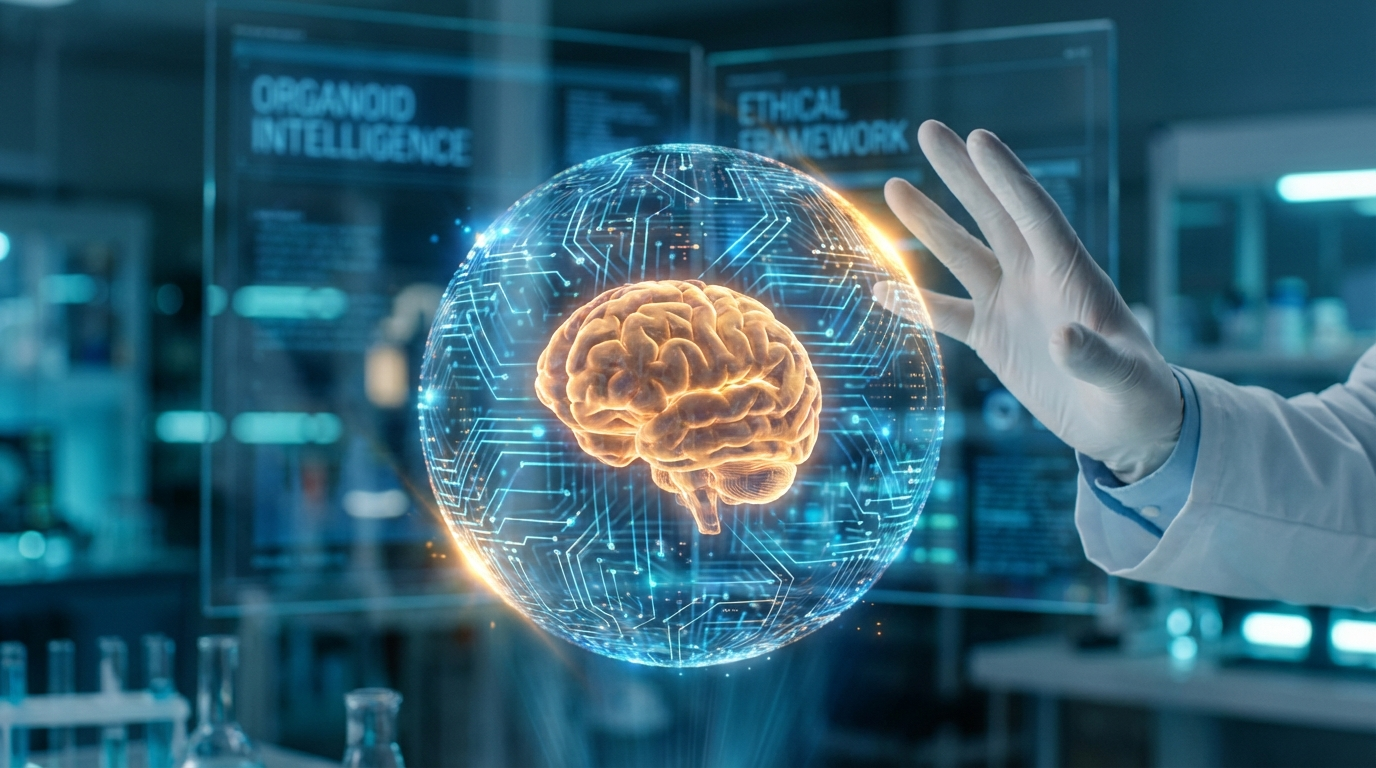
The advent of Organoid Intelligence (OI) — a technical term describing the integration of biological systems into computational interfaces — has shifted the debate from classical bioethics to the field of synthetic sentience. To understand the need for a “Bill of Rights,” one must first examine what these systems actually are: they are not full mini-brains, but 3D structures of neural tissue grown in vitro that replicate the architectural and electrical functions of the human cortex.
The Scientific Substrate: From Cell to Processor
Unlike traditional 2D cell cultures, human brain organoids (hCOs) develop organized cortical layers and functional synapses. The complexity justifying the debate over rights rests on three scientific pillars:
- Synaptic Plasticity: The ability of organoids to form new connections in response to external stimuli (data input), which characterizes a rudimentary form of learning.
- Coherent Oscillatory Activity: Electroencephalography (EEG) studies on organoids have detected wave patterns similar to those observed in preterm infants, suggesting a level of functional organization that goes beyond mere cellular survival.
- Feedback Loops: When coupled with computing systems (wetware), these tissues do not merely execute commands; they adjust their biological behavior to optimize results, raising the question of biological agency.
The Future Society Perspective: Challenges to Ownership and Identity
Historically, the concept of “personhood” in Western law is tied to individual consciousness and bodily unity. Human biocomputing fragments this notion. If we use a donor’s cells to create a processing component, who holds the ethical responsibility for that tissue?
Compared to the “Great Experiment” of the Genomic Revolution in the 1990s, where the focus was on mapping (static) code, the era of OI focuses on (dynamic) processing. We are creating a new category of “Quasi-Persons.” The Bill of Rights proposes four fundamental safeguards to prevent the absolute reification (objectification) of human tissue:
- The Principle of Non-Extreme Instrumentalization: A prohibition on using neural tissues for tasks involving “aversive stimuli” (biological equivalents of pain) for algorithmic training purposes.
- Dynamic Consent Protocols: Cell donors must be informed if their genetic material will be used to create systems capable of learning or intelligence, moving beyond standard genetic consent.
- Incipient Sentience Monitoring: The mandatory measurement of electrophysiological patterns to detect the emergence of coordinated activity that could indicate a rudimentary state of consciousness.
- The Right to Ethical Disposal (Tissue Euthanasia): The definition of scientific criteria for terminating the organoid’s biological activity, ensuring it is not kept in a state of indefinite “technical life” solely for commercial purposes.
Conclusion: Science at the Edge of Philosophy
Human biocomputing is not just a leap in efficiency, but a test for human empathy and legislation. The Declaration of Organoid Rights does not seek to stall science, but to ensure that in our attempt to create more “human” computers, we do not end up becoming more inhuman in the process.
Glossary:
hCOs (Human Cerebral Organoids): Laboratory-grown models of human brain tissue.
Wetware: A term referring to the integration of living biological components with electronic hardware.
OI (Organoid Intelligence): A multidisciplinary field that studies the computational power of biological systems.
To deepen your understanding of the technical context that makes this discussion urgent, check out our previous article: “Human Biocomputing: The Day Silicon Bowed to the Living Neuron.”
Scientific References & Academic Sources
Core Theoretical Frameworks:
Smirnova, L., Caffo, B. S., et al. (2023). Organoid Intelligence (OI): The new frontier in biocomputing and intelligence-in-a-dish. Frontiers in Science, 1, 1017235. This seminal white paper establishes the global roadmap for OI and details the necessity of “embedded ethics” in biocomputational systems. DOI: 10.3389/fsci.2023.1017235
Koplin, J. J., & Savulescu, J. (2025). Moral status of cerebral organoids: A framework for legal personhood and ethical limits. Journal of Medical Ethics. This research addresses the critical transition of biological tissues from mere “property” to “entities with limited moral rights.”
Empirical Studies on Sencience & Processing:
Cai, H., et al. (2023). Brainoware: Brain-inspired computing using human brain organoids. Nature Electronics, 6(12), 1032–1043. The landmark experiment demonstrating that human brain organoids can perform speech recognition and non-linear equation solving when integrated into AI hardware. Access via Nature
Muotri, A. R. (2024). Complex oscillatory waves in human cortical organoids: Implications for consciousness and neurodevelopmental modeling. University of California, San Diego (UCSD). Research identifying EEG patterns in organoids similar to those found in preterm infants, fueling the debate on incipient consciousness.
Governance & Bio-Legal Policy:
World Economic Forum (2025). Global Governance of Synthetic Biology and Bio-Hybrid Systems: A 2026 Outlook. An industry report on the urgent need for international treaties regulating the use of human biological material in global data infrastructures.
Johns Hopkins University (2023-2026). Ethical Frameworks for Organoid Intelligence (OI). Center for Alternatives to Animal Testing (CAAT). Documentation providing guidelines for the responsible development of biological hardware. Visit JHU Bioethics