


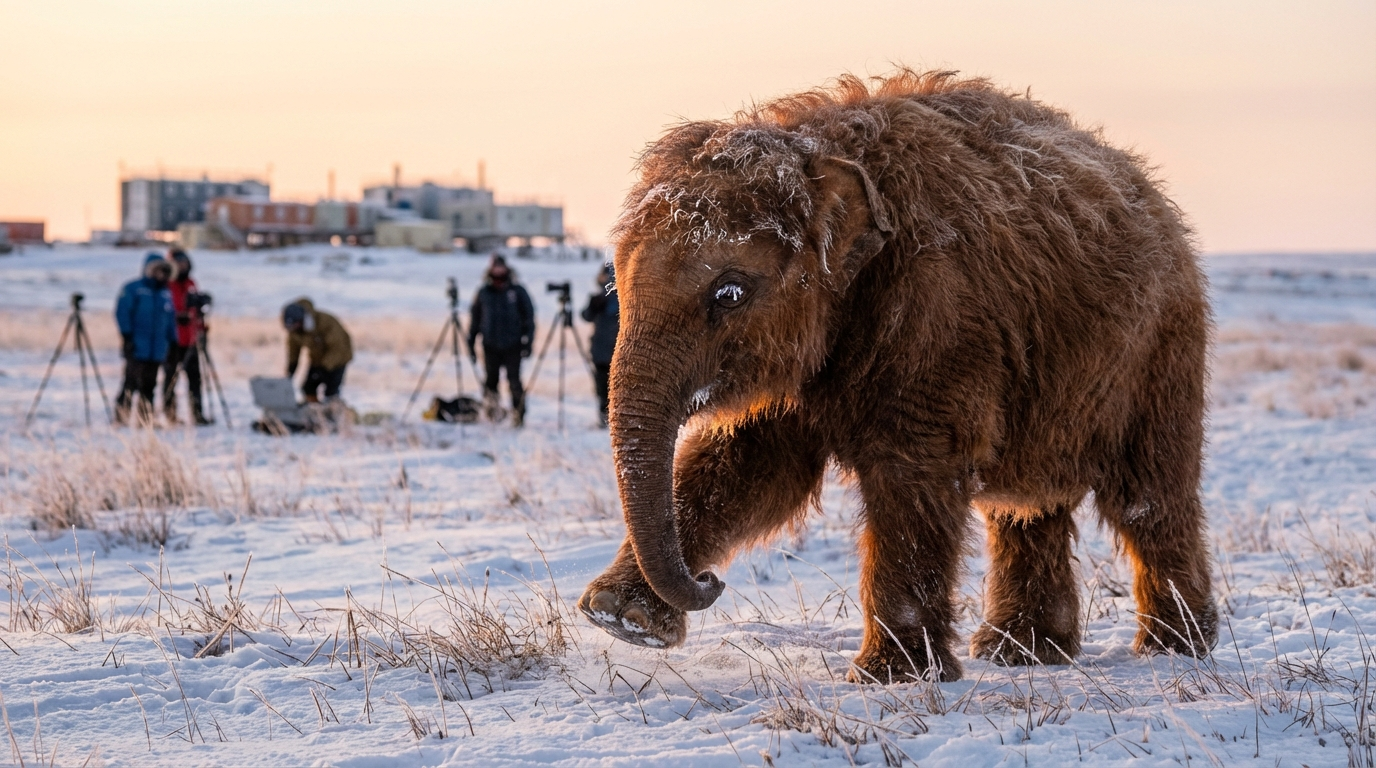
Deep within the Alaskan permafrost lies a geochemical “methane bomb” accumulated over ten millennia. If this layer thaws, it threatens to release a volume of greenhouse gases exceeding the total cumulative emissions of the Industrial Age. Curiously, the most sophisticated climate engineering solution proposed today is not a new carbon-capture turbine, but a six-ton biological relic that went extinct four thousand years ago.
The conversation surrounding de-extinction and climate change has moved from the fringes of science fiction into the boardrooms of high-tech laboratories. At the center of this debate is the woolly mammoth — or more accurately, a functional surrogate designed to perform a cold-weather task that modern ecosystems have forgotten.
The Insulation Paradox: Why Snow is Warming the Arctic
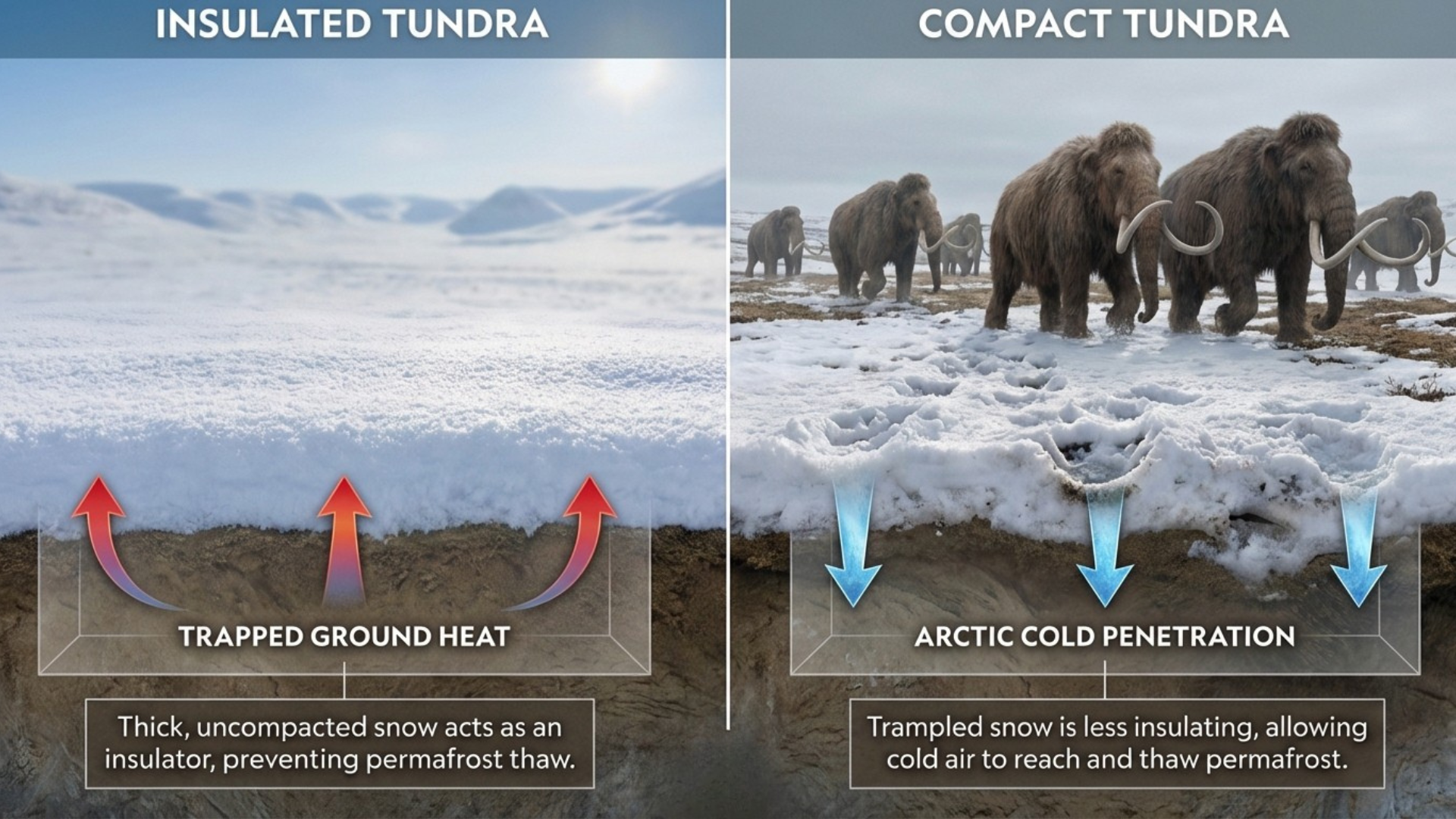
To understand why a prehistoric elephant is relevant to modern ecology, one must first grasp a counterintuitive atmospheric principle: snow is a thermal insulator. In the Arctic tundra, deep layers of “fluffy” snow act as a high-efficiency blanket. This layer traps residual summer heat and prevents the sub-zero winter air from penetrating the soil.
Beneath this white veil, the permafrost — the earth’s natural carbon vault — is effectively “cooking.” As the soil warms, the trapped methane is liberated, creating a feedback loop: more warming leads to more thawing, which in turn accelerates the warming. This is the primary driver behind the urgent study of de-extinction and climate change interventions.
The Mechanical Logic of Resurrection
The proposal championed by companies like Colossal Biosciences is grounded in Pleistocene ecology. Ten thousand years ago, massive herds of mammoths and bison acted as natural geoengineers. By constantly trampling the snow, they compacted it, removing the air bubbles that provide insulation.
This compaction allowed the Arctic frost to reach deep into the ground, keeping the methane locked in a solid state. The current strategy for de-extinction and climate change involves:
- Genomic Editing: Using CRISPR to insert mammoth traits (subcutaneous fat, cold-resistant hemoglobin) into Asian elephant DNA.
- Physical Pressure: Utilizing the animal’s massive weight to reduce snow thickness by up to 50%.
- Albedo Modification: Transitioning the tundra from dark, heat-absorbing shrubs back into light-reflecting grasslands.
The "Invasive" Ancestor: A Systemic Risk
While the climate logic is surgical, the ecological implications are vast. From an academic perspective, an ecosystem is not a static list of species; it is a dynamic network of interactions. The modern tundra has evolved for 4,000 years in the absence of mega-herbivores.
By reintroducing a six-ton architect into this fragile environment, we are — by definition — introducing an invasive species. Whether it was “native” in a previous geological epoch is irrelevant to the insects, fungi, and indigenous communities that define the Arctic today. The synergy between de-extinction and climate change mitigation requires us to ask: are we restoring a lost equilibrium, or are we imposing a human-designed one?
Ethical Escalation: The Era of Biological Utilitarianism
The most profound shift here is philosophical. We are entering an era of Biological Utilitarianism, where a species’ right to exist is tied to its measurable utility in a carbon-offset ledger.
If we accept the premise that we can “manufacture” animals to solve industrial problems, we open a door that may never close. Today, the goal is methane suppression. Tomorrow, it might be the creation of synthetic predators to manage biodiversity or engineered pollinators to replace dying bee populations. We are no longer just inhabitants of Earth; we are its lead designers.
The Question of Autonomy
In the coming years, a creature that hasn’t walked the Earth for four millennia may take its first step in Alaska. It will be a sentient being, capable of social bonds and physical pain, yet it will be born with a “contractual” purpose: to save us from our own atmospheric legacy.
The ultimate question posed by the intersection of de-extinction and climate change is not whether we can resurrect the past, but whether we are capable of respecting the autonomy of the future. Are we saving nature, or are we replacing its wild complexity with a more convenient, human-managed version?
Further Reading & Academic References
Macias-Fauria, M., et al. (2020). Arctic ecosystem restoration as a strategy to mitigate global warming. Philosophical Transactions of the Royal Society B: Biological Sciences, 375(1794). Published by The Royal Society.
Available here.
Published in Philosophical Transactions of the Royal Society B by The Royal Society, this study argues that Arctic megafauna restoration is not merely ecological nostalgia, but a structured climate mitigation strategy grounded in carbon cycle science and permafrost dynamics.
Shapiro, B. (2017). Pathways to de-extinction: How close can we get to resurrection? Science, 355(6327), 922–923. Published by the American Association for the Advancement of Science (AAAS).
Available here.
Appearing in Science, published by the American Association for the Advancement of Science, this article examines the scientific feasibility and technological boundaries of de-extinction, assessing how closely modern biotechnology can approximate functional resurrection of extinct species.
Sandler, R. (2014). The Ethics of Reviving Long Extinct Species. Conservation Biology, 28(2), 354–360. Published by the Society for Conservation Biology.
Available here.
Published in Conservation Biology by the Society for Conservation Biology, this paper explores the ethical implications of de-extinction, including ecological risk, moral responsibility, conservation priorities, and the philosophical limits of human intervention in evolution.
Contextual Citation for Script Use
“According to research published in Philosophical Transactions of the Royal Society B, Arctic ecosystem restoration through megafauna rewilding represents not speculative biology, but a deliberate climate intervention strategy rooted in carbon sequestration science.”
(Macias-Fauria et al., 2020)